# 17 Beyond The Machine: From designing better organisations to discovering what design can’t solve
Quick Summary
What we have been calling The Beyond Hierarchy Project since its launch in September 2025 is evolving—expanding its scope and adopting a new name: Beyond The Machine. "Beyond hierarchy" names one structure we need to move past. "Beyond the machine" names the entire paradigm: the mechanistic worldview that treats organisations as things to be designed, engineered, and controlled — whether from above or from within. When we let go of the machine metaphor, something else becomes possible — not a better design, but an encounter with the questions that design was never built to answer.
In this article:
Why the name no longer fits
Here's a pattern I've seen over and over — and been part of more times than I'd like to admit. A founder or leadership team decides something needs to change. Maybe it's clarifying roles and decentralising decisions into self-managing teams. Maybe it's new meeting processes, better feedback practices, different ways of collaborating and holding each other accountable. A proven methodology is followed. On paper, real progress is made — clear role definitions, explicit authority, effective meeting structures, a shared language for feedback.
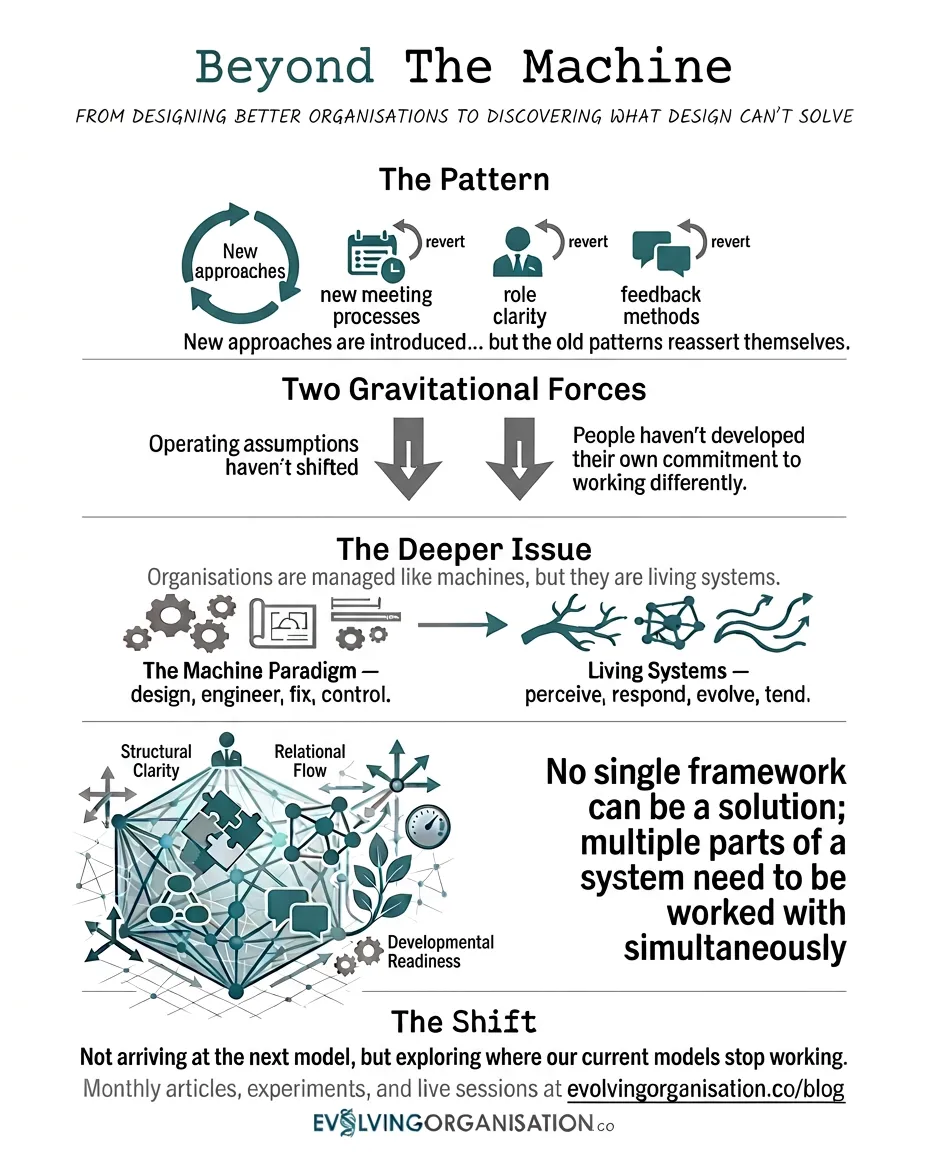
But in practice, the old patterns reassert themselves. Significant decisions still find their way back to the founders. The new meeting format works for a few weeks and then quietly reverts. People know the feedback method but don't use it. Not because anyone is resisting — and not because the new approach was unclear. It just doesn't hold. Something had been introduced from above or from outside, but two gravitational forces kept pulling it back. The operating assumptions underneath hadn't shifted — and the people inside the system hadn't developed their own commitment to working differently.
Reflecting on this and other experiences has crystallised something that has been building through the six months of working on these articles, conversations with peer practitioners and leaders doing this work in real organisations, and reflecting on my own more than thirty years of practice. I've been looking at what I've seen actually hold in organisations over time, and what quietly unravels. What makes transformation stick, and what turns out to have been rearranging the furniture.
One of the things that's become clearer is that hierarchy itself is more nuanced than a simple "move beyond it" framing allows. As Luke Kemp presents in Goliath's Curse, hierarchy is one of the defining characteristics of human civilisation — it has been with us for millennia, long before the Enlightenment, long before anyone thought of organisations as machines. And biological systems have their own natural hierarchies or "holarchies," which frameworks like Holacracy and biomimicry draw on. Some version of hierarchy will probably always show up in how humans organise.
But there's an important distinction to make. Hierarchy as a broad organising principle is ancient. Management hierarchy — the specific form in which authority flows downward through a chain of command, where the job of leadership is to predict, plan, and control, and where people are treated as resources to be allocated — is a product of the mechanical worldview. It emerged alongside industrialisation, scientific management, and the application of Enlightenment engineering logic to human work.
That's the hierarchy that the Beyond Hierarchy Project was always really challenging. Not hierarchy itself, but the particular form of it produced by a particular paradigm. I knew that, but didn't unpack it at the time. But the process of diving deeper into all of this made me realise that the name needed to change.
And for some of us, there's a quieter sense that the opportunity reaches further still. That what we're feeling our way toward isn't just better structures to replace the management hierarchy, but new ways of being, seeing, working, and living together that go beyond the ancient dominator pattern itself. I don't want to overclaim what that looks like — most of us don't yet know. But I want to be honest that the aspiration is there, and that part of this work is creating the conditions where we can find out.
The deeper issue isn't hierarchy as a structure. It's the broader paradigm within which management hierarchy sits: a mechanistic worldview that shapes how we think about organisations at the most fundamental level.
The machine paradigm
I first encountered this idea — that we see organisations as machines — reading Gareth Morgan's Images of Organisation during my MSc in Management Development in 1999. Morgan mapped the metaphors we carry without realising it: organisations as machines, as organisms, as brains, as cultures, as political systems. The machine metaphor was the one that stopped me. Not because it was wrong, but because it was so deeply embedded that most people couldn't see it operating in their own thinking. Including me, even after I had previously completed a Bachelor's degree in Social Philosophy, studied the Complexity & Emergence series of books, and then wrote my MSc thesis on 'Corporate Social Responsibility and New Paradigm Thinking'.
Twenty-six years later, I'm surprised by how pervasive this thinking still is, and how it still shapes so much — and I'm not alone. It sounds like Mark Eddleston is on a similar journey, in his New Ways of Working series. He has been tracing how this linear, mechanistic paradigm continues to underpin mainstream management thinking — and why organisational development efforts keep failing as a result. His argument that we need a genuine paradigm shift, not just new tools applied within the old paradigm, aligns with what I'm describing here.
The logic is everywhere, and it runs deeper than most of us realise. We talk about organisational design. We engineer processes. We look for the levers of change. When something breaks, we diagnose the faulty component and fix or replace it. And we reach for a single fix — a methodology to implement, a framework to roll out, a culture programme to install — as if a complex, adaptive human system can be repaired the way you'd swap out a component on a production line. Even when we try to move beyond hierarchy, we often do it with the same machine logic — we design a flatter structure, we build a culture of psychological safety as though it were a feature to be installed. The architect may move from the boardroom to the workshop floor, but the paradigm doesn't change. This isn't a quirk of management language. It's an inheritance from the mainstream modernist worldview — the mechanical universe of the Age of Reason and the Enlightenment. This worldview gave us extraordinary things. But when we apply it to human systems, it reaches its limits in ways that most of us can feel but struggle to name.
Then we're surprised when it doesn't hold.
That's not a failure of execution. That's the machine paradigm reaching its limits.
What opens up
So what happens when you let go of the blueprint — not just the top-down version, but the whole logic of designing and engineering organisations?
The most durable transformations I've seen come when people within a system develop the capacity to perceive and respond to what's actually happening — for themselves, not because it's been imposed or diagnosed from the outside. When a team learns to notice its own patterns — not because a consultant pointed them out, but because the people in the team have learned to see them — something fundamentally different is at work. That's not a machine being redesigned. That's a living system developing new perception.
Three dimensions carry the core of this shift. The practices of Self-Managing Teams (many of which are derived from methodologies like Holacracy or Sociocracy) — explicit roles, distributed authority, governance that evolves through tension processing — create structural conditions for something alive to happen. Relational infrastructure (from Matrix Leadership) — the web of trust, honest communication, and genuine connection between people — is what makes structural clarity actually function. And developmental readiness (from Terri O'Fallon and other models of adult development)— where people actually are in their capacity to hold complexity, share power, and work with emergence — play key roles in whether any of these practices will land or bounce off.
What does this look like in practice? I've watched teams where someone notices a tension — a gap between how things are and how they could be — and instead of escalating it to a manager or letting it fester, they bring it to a governance meeting and propose a structural change. The proposal gets processed in twenty minutes. The role evolves. The tension is resolved. No committee, no approval chain, no six-week review cycle. Not because someone designed a more efficient process, but because the team has developed the capacity to sense what needs to change and act on it — structurally, relationally, and with enough developmental readiness to trust the process even when it feels unfamiliar.
When you hold all three dimensions together, you're no longer designing a machine. You're tending a living system. And the results — when they come — tend to hold in a way that redesigned structures alone rarely do, because they're grounded in the team's own perception, not in an external blueprint.
And even these three dimensions are only part of the picture. Over thirty years, I've come to see that durable transformation touches more of the system than any single framework can reach — the lifecycle stage of the organisation (Ichak Adizes), the cognitive styles of the people in it (Linda Berens), how impact is measured (Sean Esbjorn-Hargens), how the purpose connects to the broader world (Tim Kelley), how the experience of transformation itself happens (Marisa Murgatroyd). When multiple dimensions are addressed together, things are more likely to hold. When only one or two are worked with, the change often takes root in one place and quietly unravels in another. That pattern — of partial interventions producing partial results — has been one of the most consistent things I've observed across three decades of this work.
Beyond The Machine
So, The Beyond Hierarchy Project is becoming Beyond The Machine.
The subtitle: From Designing Better Organisations to Discovering What Design Can't Solve.
"Beyond hierarchy" named what we needed to leave behind. "Beyond the machine" names the deeper assumption we're leaving behind — and the subtitle names what we're doing instead: not arriving at the next model, but honestly exploring the territory where our current models stop working.
None of this is easy. Recognising that there are no single answers, simple solutions, or silver-bullet frameworks and that reality is messy - this work becomres more about about opening up to that reality rather than trying to tidy it away. It means sitting with more uncertainty than most of us are comfortable with. It means trusting processes you can't fully control. It means being willing to be changed by the work, not just to change others through it.
But if you've been sensing that something fundamental needs to shift — that better design and engineering isn't the answer — then you already know this. You've probably tried it. You've probably found that it helps for a while, and then the old patterns reassert themselves.
This is where the work begins.
What to notice
This week, you might try something. Listen to how you and your colleagues talk about your team or organisation. Notice how often the language reaches for the machine: fixing, designing, engineering, building, driving, levers, mechanisms. You don't need to change anything. Just notice it. See whether — once you start listening for it — the machine metaphor is more pervasive than you thought.
And then notice what other language is available. What words would you use if you were talking about something alive?
What's coming next
We'll continue with the articles, and are introducing a new, slower rhythm: experiments you can try in your own team, followed by monthly webinars where we share what we noticed. Try something, notice what happens, talk about it together.
Everything I've described in this article — the limits of the design-and-fix approach, from single-dimension interventions to working with the whole system, from imposing change to developing a group's own capacity to perceive and respond — is what shapes the work we offer at Evolving Organisation and also in another initiative that I am co-founding: the Bjärkan Resilience Project.
The Evolving Collective Leadership program builds the relational dimension online, in a live group over four months. Bjärkan provides the container where that work meets land, body, and sustained time together — the kind of immersive experience where deeper patterns can surface and shift. And Beyond The Machine continues the weekly conversation about what all of this means in practice.
Here's what we have coming:
Evolving Collective Leadership — Founding Cohort (starts 14 April)
Amina Knowlan from the Matrix Leadership Institute and I have spent the past year developing a programme that addresses the relational dimension of collective leadership — the dimension that most organisational change efforts skip entirely. The founding cohort launches in April with a 33% discount for those willing to help us shape it. Seven live sessions over four months, online, focused on the practices that transform how groups actually function together.
Summer at Bjärkan Resilience Project, northern Sweden
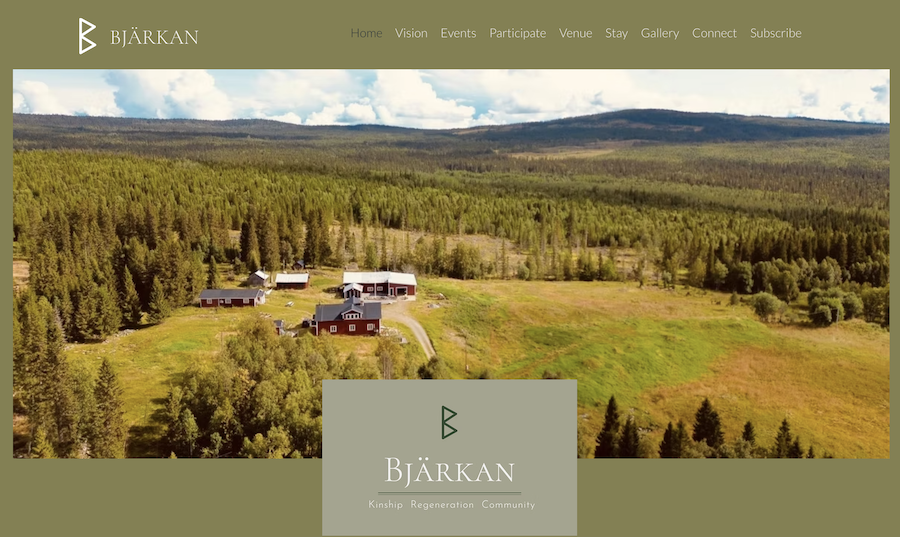
In Jämtland, northern Sweden, my wife Justine and I run the Bjärkan Resilience Project — where the work of evolving living systems meets actual living systems: forest, lake, and long summer light. This summer, we're running four events:
Volunteer Community Gathering (30 June – 11 July) — Twelve days of shared work and communal living: land care, building, forestry, and the experience of what community actually feels like when you're doing something real together.
The Gathering: A Summer Retreat (17–23 July) — A six-night retreat at the wild edge, rooted in systemic ritual, constellations, embodiment, and nature connection. Held by Justine.
Meeting at the Threshold (19–29 August) — A ten-day residential training in resilience skills for uncertain times, through shared learning and a hands-on building project.
Evolving Collective Leadership Residential (2–9 September) — Eight days of residential training in relational leadership, co-facilitated by Amina Knowlan and me. This is where the relational infrastructure work goes deep.
Explore the full summer programme at bjarkan.org →