
You've been doing everything right. So why isn't it working?
Are you interested in adopting new ways of working in your team... but can't afford a false start?
Before you invest in a new approach, get an honest picture of what's actually happening in your team — not just the symptoms you can see, but the patterns underneath them.
The gap between reading about it and actually doing it
Maybe you've been reading about this stuff for a while. Or if you've been following the Beyond the Machine articles — or spent time in a Live session — something may have started to shift in how you see your team's situation. You can feel the gap between how things work now and what feels possible. You have a sense that the problem runs deeper than the obvious symptoms.
But there's a distance between that felt sense and being ready to take your team through something new. And if you've tried to close that distance before — a training, a new process, a restructure — and found it didn't hold, you know why that distance matters.
Most change efforts fail not because the approach was wrong but because the questions that really needed answering weren't asked first. Not just "is this the right methodology?" but "what's actually going on in our specific team, right now, and what would actually help it?"
That's what this is for.

Four questions worth answering before you commmit
1. What's really going on - not just what I can see?
You know the symptoms. The decisions that keep getting kicked upstairs. The meetings that drain more energy than they produce. The good people who've quietly stopped bringing their best thinking. But symptoms can have very different causes, and the habit of treating organisations as mechanisms — find the fault, fix the fault — tends to make us look for the most visible one. Unclear roles look like a communication problem. Relational tension looks like a process failure. A mismatch in how people hold complexity looks like resistance or laziness. The patterns underneath often stay invisible precisely because we're not looking for patterns — we're looking for parts to fix. What becomes possible when you let the system show you what's actually going on, rather than arriving with a diagnosis already in hand?

2. Will my team actually get on board with this?
You've had a journey that brought you here. Your team hasn't had the same one. If you introduce something new without genuine buy-in — even something genuinely better — the most likely response isn't enthusiasm, it's quiet resistance. Not because people are difficult, but because change that arrives from above or outside, without people having a chance to experience its value for themselves, doesn't take root. The most reliable path to real commitment is letting people taste something small, see it work, and choose to go further. You need to know whether your team is ready for that — and what would need to be true if it isn't yet.

3. Is this the right moment?
There's never a perfect time. But there are genuinely wrong ones. If your team is burned out, in the middle of a crisis, or already carrying too much, introducing something new — however good — is likely to fail. Not because the approach is wrong, but because the ground isn't ready for it. Understanding your team's current capacity, stability, and openness tells you whether change could take root or whether you'd be fighting against the conditions before you'd even started.

4. What's the right path forward - specifically for us?
Not "which programme should we do?" but "given what's actually happening in our team, what does it actually need?" That might be structural clarity — clearer roles, cleaner decision authority. It might be relational work — rebuilding trust and honest communication. It might be addressing something in how people hold change, or where the organisation is in its lifecycle, or how it measures what matters. It might be several of these in a specific sequence. You need a picture built from your reality, not a generic recommendation applied to your situation.

Cross the Threshold
An inquiry & pilot support package- not a training course
What the next 90 days is actually for
Not to prove whether your team can handle a new way of working. Not to pilot a methodology. But to get a clear, honest picture of what's actually happening across your team — and to let that picture tell you what it needs. That's a different kind of work than most change efforts attempt. And it's the kind where the picture that emerges is genuinely yours — not a template applied to your situation.
Over 90 days, you'll develop a clearer picture of what's happening in your team — starting with the structural, relational, and developmental dynamics that are most immediately visible, and surfacing the other patterns that are quietly shaping what's possible. You'll test new practices at low risk with expert support. And you'll come away with either a concrete path forward grounded in what you've actually discovered about your team — or the honest knowledge that now isn't the right time. Either way, you're making a grounded decision instead of a hopeful guess.
If the path forward does lead to one of our programmes, you'll be starting it with a real picture of your team's situation — which changes everything about how that learning lands.
The 3 Steps at this Threshold
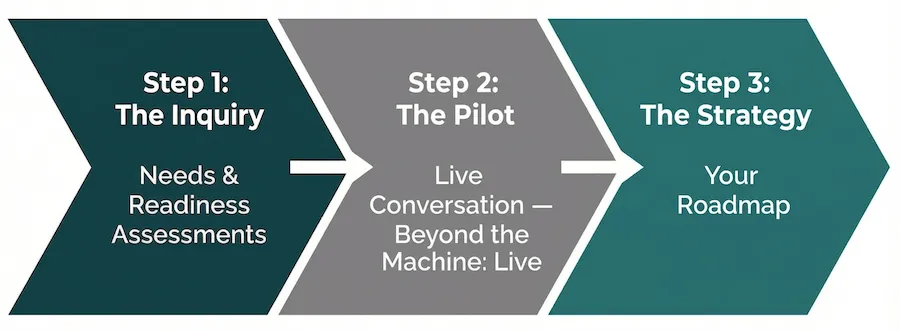
What's Included
STEP 1 / PART 1
NEEDS ASSESSMENT
An inquiry into what's actually going on in your team — not just the symptoms, but the patterns underneath. Where is the real friction? Is it structural, relational, developmental — or in patterns most teams have never thought to look at? This gives you a picture of the whole landscape, not just the part that's most visible.
VALUE £150
STEP 1/Part 2
READINESS ASSESSMENT
An honest assessment of your team's current conditions — the buy-in, the stability, the openness, the capacity for change. This isn't a pass/fail test. It's a picture of the ground you'd be working with, so you can understand what would support change and what might undermine it before you commit your team's time and goodwill.
VALUE £150
STEP 2
Live GROUP COACHING
You and two colleagues get access to our monthly live group coaching at Beyond The Machine: Live for three months. This is where the real learning happens — you bring what you're noticing in your team as you try new things, the patterns emerging from the assessments, the questions you didn't know you had. You're not committing to a programme. You're making the invisible dynamics in your team visible, with support.
VALUE £171
STEP 3
STRATEGY CALL & ROADMAP
A one-hour call to make sense of everything you've discovered — the assessment results, the experiments, the patterns that have emerged. This is where the full picture comes together: given what we now understand about your team, what does it actually need? That might be one of our training programmes. It might be a combination. It might be something we don't offer. It might be "not yet — and here's what would need to shift first." You'll come away with a roadmap grounded in what you've actually seen in your own team, not a recommendation shaped by what we happen to sell.
VALUE £500
Total Value £971 > Your Pilot Price £495
This is deliberately priced to remove a barrier to getting started. We'd rather you understand your team's situation and make a well-informed decision than skip this work and risk an expensive false start.
We limit the number of packages we deliver per month to ensure the support is genuine.
WHY THIS INQUIRY IS DIFFERENT
What this inquiry makes visible that most change efforts never look at
Most organisational assessments look at one or at most two dimension at a time — structure, or culture, or process, or team dynamics, or psychometrics, or maturity. Each one offers something useful. The problem isn't any individual assessment. It's the habit of treating each dimension as separate, as though fixing one part of the system won't disturb the others.
If we take seriously the idea that organisations are living systems — where structural, relational, developmental, and contextual patterns are all actively shaping each other — then looking at one dimension at a time isn't just incomplete. It's how the most important patterns stay invisible. A structural problem rooted in relational dynamics won't respond to structural fixes. A leadership issue that's really about lifecycle stage needs a completely different intervention.
Cross the Threshold works across eight dimensions. The frameworks named in each — Self-Managing Teams, Matrix Leadership, the STAGES Model, and the others — aren't named here as diagnostic instruments or methodologies to adopt. They're ways of perceiving what's happening in a living system, and of understanding what it might need.
STRUCTURE
Role Clarity, Governance & Decision-Making
How authority is defined, are roles clear, how decisions get made, methods and protocols for collaboration.
MATRIX LEADERSHIP
Relational Infrastructure
The quality of trust, communication, and genuine connection. The invisible web of connections that makes structural clarity actually function.
STAGES MODEL
Developmental Readiness
Where people actually are in their capacity to hold complexity, share or distribute power and work with emergence.
ADIZES INSITUTE
Organisational Lifecycle
Where the organisation is in its lifecycle, and which interventions fit that stage rather than fighting against it.
INTERSTRENGTH INSITUTE
Psychometrics
Where people actually are in their capacity to hold complexity, share or distribute power and work with emergence.
THE EXPERIENCE GROUP
Customer & Employee Experience Design
Why technically sound interventions fail to embed when the experience of going through them isn't considered.
METAIMPACT FRAMEWORK
Impact Measurement
Whether you're measuring what actually matters, or just what's easy to count. Using a framework of 10 types of capital to support a Wisdom Economy.
TRUE PURPOSE INSITUTUE
Context & Purpose
How the organisation connects to its broader purpose and the stakeholder ecology it exists within.

Your Guide
I've spent thirty years developing the capacity to learn and work with a wide range of frameworks to perceive organisations across all eight of these dimensions simultaneously. That's not something that came from a single training or certification — it evolved over decades of practice, starting with one or two frameworks and gradually integrating more as I encountered the limits of each one in isolation.
As one of seven Holacracy Master Coaches worldwide and a Certified Experience Design Consultant, I've worked with thousands of people across organisations from startups to Shell and Ernst & Young. But the most valuable thing I bring to the strategy call isn't any single credential — it's the ability to see what's happening across the full picture and help you see it too. That's what this inquiry is built on, and it's what makes the roadmap genuinely yours rather than a generic recommendation.
Nick Osborne, Founder & Lead Trainer, Evolving Organisation







Is this for you?


For You If
Not For You If
You're in a team of three or more people. Something about how the team works isn't right — and you sense it might be more than a surface problem. You've been reading about different approaches, or experimenting with new practices, and you want to understand your team's specific situation before committing time, energy, and goodwill to something new. You're willing to let the picture emerge from what you actually find rather than confirming a decision you've already made. And you have enough influence to get your team to participate in two short assessments and some low-risk experiments.
You've already decided what the answer is and you're looking for support to implement it. Or you're hoping the 90 days will hand you a clear prescription .
This inquiry surfaces what's actually happening, but what to do with that picture requires you to engage with the uncertainty alongside us, not receive a solution from above. Or you don't have the ability to get your team involved — understanding a living system requires being inside it, not observing it from a distance.
Who Is This For?
For You If
✅ You are in a team of 3+ people.
✅ You are in pain/struggling with some aspects of how things are working in your team.
✅ You sense there must be a better way to do things, but you are not ready to commit to training your team yet.
✅ You are willing to experiment.
✅ You can get the rest of your team to participate in the two assessments and some experiments.
