#25 Can This Meeting Be an Autonomous Decision?
By Floris Hammer, Loving Work.
Quick Summary
What percentage of your work week do you spend in meetings? And how efficient do these meetings feel? Would you say you need more meetings to be more effective in your work, or fewer?
We often ask each other "can this meeting be an email?" as one of the symptoms — and possible solutions — to meeting overload. In this article, I'll propose a different avenue to explore: using autonomous decisions as an alternative to ever more meetings.
I think it's safe to say that many of us working in organisations across industries experience problems with both the amount and the quality of meetings in the workplace. In this article I'll explore both, and suggest a few powerful shifts in attitude and practice that can save time and generate much more flow in collaboration. The examples come from my own experience in dozens of organisations of all shapes and sizes. The practices are tried and tested.
Underneath all of this sits a question that often stays unasked: what does our habit of scheduling meetings tell us about what we believe — about who is allowed to decide?
Meeting addiction isn't just a habit or an inefficiency. It's structurally produced. The predict-plan-control logic of conventional management requires everyone to stay continuously coordinated at the centre, because authority flows up — no-one below a certain level can make a call without checking. The meeting isn't really the problem; it's where authority lands when it has nowhere else to go. That observation, held lightly, changes what we're actually looking at when we look at meeting culture. As we move beyond the machine paradigm, new possibilities open up.
In this article:
Addicted to Meetings
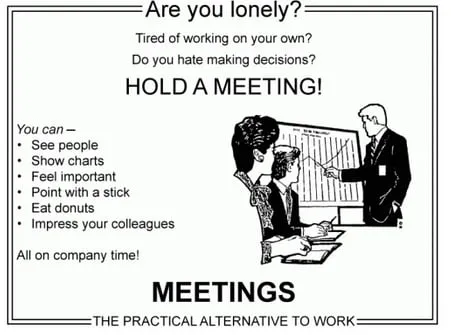
We have more meetings than we need, and the standard solution to almost any problem appears to be: let's plan a meeting.
From weekly team meetings to daily stand-ups. From impromptu brainstorms to regular one-on-ones. Working groups, task forces, kick-offs, workshops, all-hands, and informal sessions. There are as many types of meetings as there are petals on a blossoming cherry tree. Many of us spend 30 to 80 percent of our working hours around a conference table or in an online meeting room, talking and listening to other people.
I've been in meetings that felt energising and amazingly productive — but many don't. And yet we seem to be addicted to them.
Have a new idea? Let's plan a meeting. Results for last quarter aren't what we expected? Let's get the right people in a room.
The core pattern is often the same: getting people together becomes the main action we take when a problem, question, or opportunity arises. In fact, I often observe that the only concrete outcome of a meeting is… planning the next meeting.
This habit is usually well-intended. And sometimes the best next step really is to think together. But I believe we could use a bit more consciousness around the other options we have.
A painful lesson
In my first job, fifteen years ago, I participated in a team workshop. The team coach gave our group — about ten people — an assignment: solve a modestly difficult question involving reading a situation and doing some calculations. We had fifteen minutes to arrive at an answer.
What followed was painfully memorable. People immediately started suggesting answers. Others jumped in to explain why they were wrong. Volume rose. Attempts to take the lead were overruled or ignored. I tried to focus on the problem — to read and calculate in the midst of the noise — and was accused of sabotaging the group process by withdrawing.
In the end, the group decided on an answer. It was wrong.
What failed here wasn't intelligence or goodwill. It was the assumption that collective talking is always the best way to think.
This problem was far better suited to a different approach: one or two people taking five minutes to read, think, and write out a solution in a structured way. They could then have presented the result, answered questions, and integrated feedback. Almost certainly, within ten minutes, we would have reached a correct, shared answer.
I see this pattern everywhere. We try to solve problems by talking about them in groups, while no one gets the space to do the actual work: assembling information, analysing the situation, thinking through options, or drafting a proposal.
Most problems require a balance between talking and working. And most work is best done outside of meetings.
Before you plan the meeting
Work often benefits from solo or distributed focus time, while meetings are most useful for coordination and integration. So when a problem or idea comes up and you notice the reflex to plan a meeting, pause and consider:
Does something concrete need to be done — designed, written, analysed, built, contacted, or decided?
Is the desired outcome clear enough to name and assign?
Does someone need to gather or synthesise information first?
Could someone come up with a proposal, so a potential meeting doesn't start from scratch?
Focusing meeting time on integrating work — rather than replacing it — can dramatically reduce the number of meetings you have. And it sets the stage for the meetings that remain to be far more effective.
Meeting with a purpose (instead of by default)
Even when meetings are truly needed, many of them are ineffective. They exchange opinions without producing movement.
"So, thanks for joining this meeting about X. We all agree it's urgent. What shall we do about it?"
When a meeting starts with a vague invitation to open discussion, chances are high that it will drift into group dynamics, tangents, and a lack of concrete outcomes. This is rarely a failure of the people involved — it's a failure of process.
Small structural choices can make a big difference. Simply naming the purpose of the meeting and assigning a facilitator already changes the quality. Matching the shape of the meeting to its purpose changes it even more.
What follows isn't a meeting design framework. It's a description of what coordination tends to look like when you're transitioning out of meeting-by-default culture. Different purposes call for different shapes of conversation:
Status update / stand-up. Brief and time-boxed. Focused on transparency and flow, with minimal discussion.
Decision-making meeting (consent or consultative). Explicitly structured to reach a decision on a specific proposal.
Tactical / triage meeting. Process-driven, operational, focused on identifying next actions or projects — one issue at a time.
Workshop / brainstorm. Activity-based sessions for generating ideas or solving complex problems, requiring strong facilitation.
Retrospective / after-action review. Structured reflection aimed at learning and improving future practice, not assigning blame.
Information sharing / all-hands. Primarily for broadcasting information, ideally brief and paired with focused Q&A.
When you receive a meeting invitation that worries you — or when you find yourself scheduling the next meeting — resist the temptation to "trust the process" if the process isn't clear. Once it is clear, trusting it can channel collective creativity remarkably well.
And even then: meetings are only one ingredient.
Alone-time and ownership
If meetings are where we integrate work, then solo time is where most of the actual work happens.
Many people I work with crave more time away from meetings. They feel they no longer own their agenda and are forced to do real work at the edges of the day — or in their free time. I often suggest explicitly planning blocks of solo time and treating them as at least as sacred as meetings. But there's a deeper layer here.
Doing the work — the thinking, drafting, calculating, deciding — requires making choices. And making choices always involves risk: choosing a suboptimal path, wasting effort, or exposing your work to criticism. When you act autonomously, you own the decision. And ownership comes with vulnerability.
One of the things that can make this vulnerability more manageable is clarity about roles and accountabilities. When it is clear who owns what, and what authority comes with that ownership, taking autonomous decisions becomes less ambiguous and less exposed. You're not stepping on someone else's toes, nor waiting for implicit approval — you're simply acting within your role. This kind of clarity doesn't remove the need for courage, but it does provide a structure that makes autonomous action far more natural and sustainable.
Thinking back to my experience in the team assignment: no-one had the explicit role of thinking the problem through and making the required calculations. That meant all of us were trying simultaneously, with the disastrous results I described.
Even with more role clarity in place, I believe it's often this vulnerability — combined with cultural pressure — that subconsciously drives us away from autonomous action and toward death-by-consensus. Meetings can become a way to dilute ownership rather than enable collaboration.
The antidote is acknowledging a simple truth: most real-world impact is created by doing something, not by talking about it. And that doing still requires courage. Moving toward a culture that rewards this courage — and invites autonomous action as a healthy counterbalance to meetings — is not easy. But you can start by setting the example.
Show up to your next meeting with a concrete proposal. Ask for objections rather than permission. Thank colleagues when they take action instead of waiting.
And ask yourself not only:
"Can this meeting be an email?"
But more boldly:
Can this meeting be an autonomous decision?
What to notice this week
This week, you might try noticing one thing. Each time you schedule, accept, or find yourself sitting in a meeting, ask yourself: is there a decision being discussed here that someone in the room already had the authority to make without us all gathering?
You don't need to do anything about it — just notice. Notice how often the answer is yes. Notice the small moment of hesitation that sometimes precedes a unilateral decision, even when it's clearly inside someone's remit. That hesitation is worth paying attention to. It tells you something about how authority is actually held — not in the formal structure, but in the shared, often unspoken understanding of what people feel allowed to do.
It's a small lens, but once you've looked through it, it can be hard to unsee.
Next week, we'll be publishing a short experiment drawn from this article — one specific thing you can try in your own team. If today's piece has resonated, it'll give you a way to test the question on the ground.
If you've been recognising your team in any of this — if the gap between how many meetings you have and how much actually moves is starting to feel structural rather than personal — there's space to explore it further. Nick Osborne runs Beyond The Machine: Live, a free monthly conversation for leaders working with these questions.