#11 Beyond Hierarchy ⚖️ Legitimacy is Key 🔑
I work in a large organisation of volunteer activists. There are thousands of grassroots members and about 150 people working in teams within the Anchor Circle at the centre of the organisation. Working with volunteers creates unique challenges as there is a large throughput of people, so the level of understanding and skills in working in Self-Managing Teams (which I refer to here as Self-Organising) is always on the low side. Along with this is the fact that activists are often driven by very strong emotions, which sometimes lead to very different ideas about what the organisation should be doing. This combination is a challenge for any system of organising. Despite this, the organisation has been using its variant of Holacracy successfully (in most teams) for a number of years.
I have been working in this organisation as a self-organising coach for six years. The system we use is a variant of Holacracy (a simplified form, with some changes to fit with the organisation’s ethos). I have learned many things watching this organisation progress in its self-organising journey. It’s various struggles and many successes.
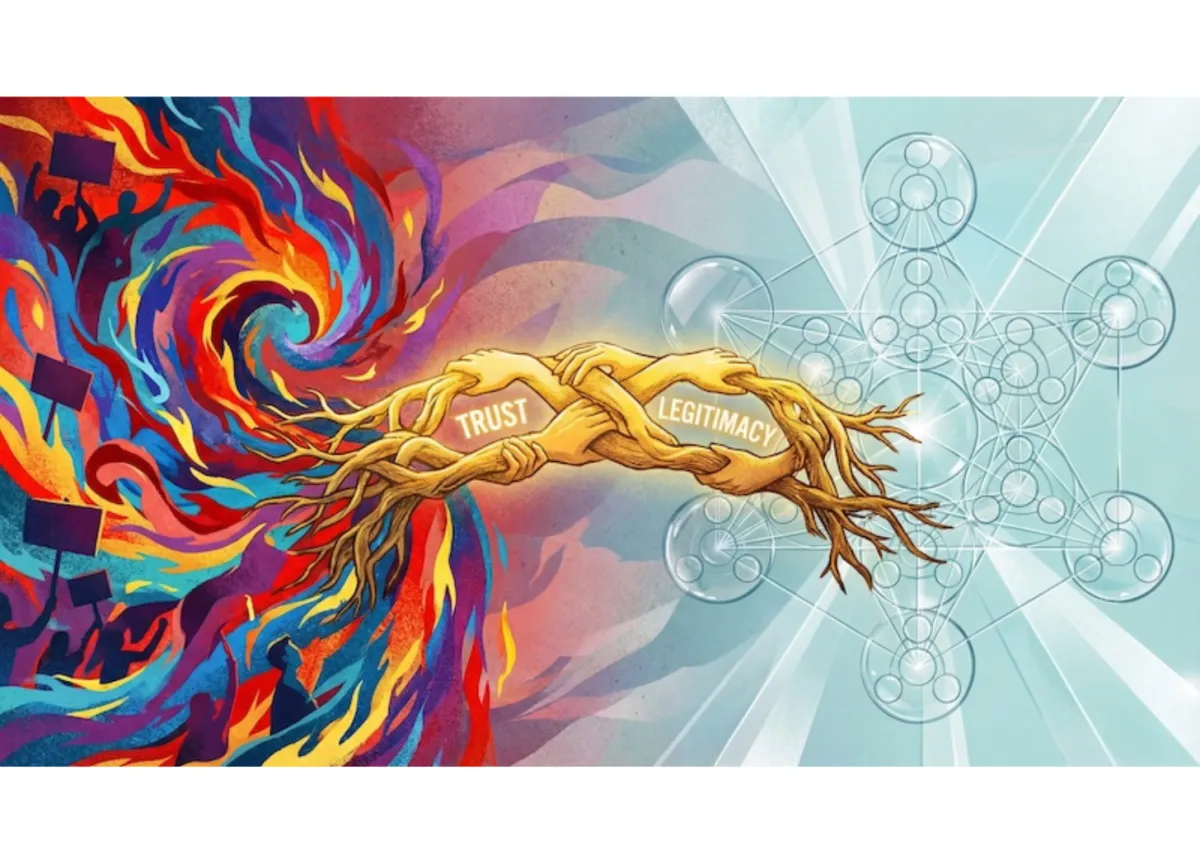
One of the big takeaways that has arisen, almost from the beginning, and remains vitally relevant up to the present day, is the importance of legitimacy. The question that arises here is: what gives decisions made within the rules their legitimacy? You could also ask, what gives the rules themselves legitimacy?
What happens without legitimacy?
Without sufficient legitimacy, my experience is that decisions made within a role or by consent within a team are not only questioned but sometimes acted against. This is particularly apparent in a voluntary activist organisation where people are there because they feel very strongly about an issue. This strength of feeling can override everything else for some people. Asking them to see the bigger picture, the importance of organisational coherence, alignment with strategy, etc, resonates with many, but simply doesn’t land with certain people. For these people, the rules need a more powerful claim to legitimacy.
We have tackled this issue in a variety of ways. Training emphasising how decision-making power is delegated to mandates via the consent of a group has helped. Explaining that your role’s authority to make a decision was granted by its sibling roles (via consent). I’m choosing the words I’ve used to explain this very deliberately here (eg: “granted”, “sibling” “, delegated”). The aim is to frame explanations in terms of the legitimacy of decision-making. And to try and guide people away from the mindset of “This is my piece of autonomous turf” and towards the idea that mandates are a delegation of the authority held by the wider group.
If people don’t like how it’s working, ask them to suggest better alternatives
I have also found that asking people during trainings to suggest alternatives to this way of making decisions is helpful. Because as soon as they start looking at that, they realise that all the other roads lead to either hierarchy or consensus, neither of which most people (at least in this organisation) realise will work for them. Getting people to do some of their own thinking in this context can, I find, be helpful in getting buy-in (legitimacy) for the system. It can also help move people from a sort of “passive workshop mode” to actively engaging their brains with the concepts.
Another way we have tackled the problem of legitimacy is to have elected representation from stakeholders outside the organisational structure in the Anchor Circle, along with the sub-circle reps. As this is a grassroots organisation, representation from local and regional groups gives legitimacy to the central teams within the anchor circle. In the eyes of central teams, this grassroots representation also helps provide legitimacy to our written Constitution, which the Anchor Circle holds.
The importance of trust
Finally, and at least as important as the other things I’ve talked about, is establishing trust through building personal relationships. Humans often rely more on emotion than reason. So explaining that a decision was made using the rules they’ve agreed to work by isn’t always enough if someone doesn’t like that decision. On the other hand, even if you strongly disagree with a decision, if you feel a sense of trust in some or all of the people who made it, you are more likely to accept its legitimacy.
Challenges with building trust & legitimacy
What can play against this with volunteers is meeting time. We have talked about Tribe Space within the organisation, but it’s very difficult to convince volunteers to attend extra meetings that don’t result in tangible work. But we have seen the ill effects of not doing this. There are times when decisions are questioned because of serious disagreements about what the organisation should be doing. When this happens, without strong bonds of trust, it puts a lot of pressure on the rules and individuals in coordinating roles.
In addition, many people are so used to the hierarchical culture of having a manager who mitigates their behaviour. This means that they are not used to managing their own behaviour. It also means that without the sanctions a manager would impose if they go against a decision, they feel empowered to sometimes ignore them.
Ways we are trying to mitigate these challenges
When giving trainings, I find that using pictures and tone of voice to emphasise key concepts can be really helpful in getting them across. It’s easy for those of us with a university education and experience in Holacracy or similar self-organising structures to forget that terms like “mandate,” “consent,” “delegated,” “authority,” and “autonomous” don’t carry the same meaning for the uninitiated. So I find it really important to keep checking in with people during training to make sure they’re really understanding what’s being explained.
Our trainings encourage everyone to think about and act from their roles, rather than defaulting to a broader cultural reliance on the parental role of a manager.
All of this helps, but sometimes, at least in an activist organisation of volunteers, disagreements are so passionate that more is needed. We are currently working on an initiative to bring greater legitimacy to major decisions amid significant controversy.
Thirdly, we use the advice process widely (sometimes too widely). This not only provides essential information on the impact of decisions, but it also makes people feel their views were heard, even if they are not directly involved in making the decision.
The fact that this system works as well as it does in an organisation of passionate activist volunteers is, I think, a testament to the effectiveness of this way of organising. But building legitimacy for the system so that people agree to hold to it, even when things aren’t going their way, is an important part of the equation.
Co-author a future working together beyond hierarchy
We are crowd-sourcing a book to challenge global assumptions about hierarchy and power, and we need your field notes.
Been there? We want to hear the good, the bad and the ugly. If you have experience with these practices, tell us what happened at evolvingorganisation.co/thefield.
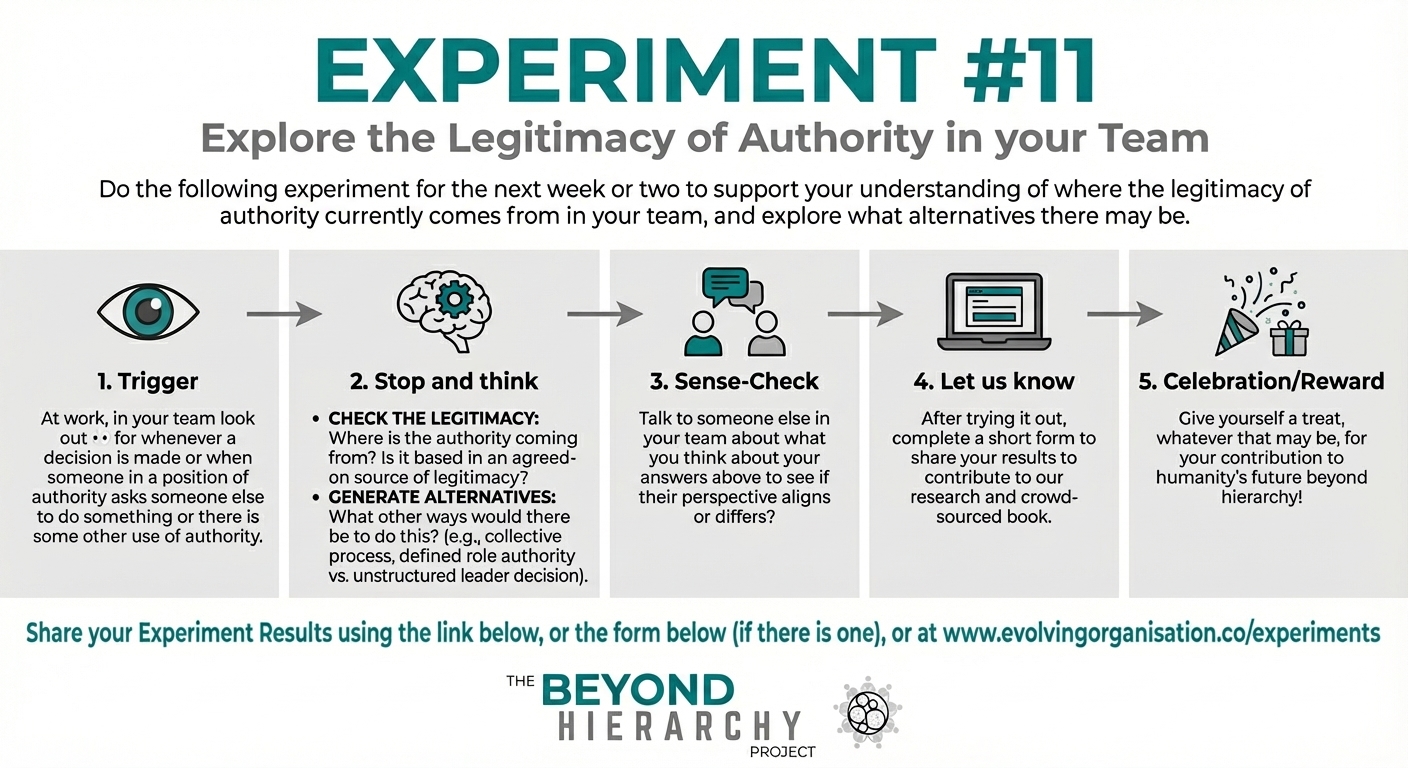
New to this? Feel the pain of the old way and sense there must be something better? Try the experiment below and share your results in the form underneath it.
Don't just read about the shift. Be the proof. We thank you for playing your part in this service to humanity.