#19 EXPERIMENT- Try It: Map Who's Actually Talking
An Observation Experiment from the 'Attention to the Whole' Article #18
Quick Summary
This is a hands-on observation experiment you can try in your next meeting — no preparation, no change to how the meeting runs, and it takes less than a minute to set up. You'll track who speaks (and, if you want richer data, who speaks to whom) using nothing but a pen and a blank sheet of paper. What shows up on the page is a concrete picture of how your group's conversation actually flows — who's in it, who isn't, and where the intelligence in the room is and isn't being heard. It builds on last week's article on 'Attention to the Whole', and you don't need anyone's permission to try it.
In this article:
Last week's article — Attention to the Whole: When Good Relationships Aren't Enough — explored what it means to track a group as a system, not just your own experience within it. This week, you can see one of those group-level patterns for yourself.
This is an observation experiment. You won't change anything about your meeting. You won't intervene, facilitate differently, or draw anyone's attention to what you're doing. You're simply going to watch one pattern that's been there all along — and write down what you see. Most of us have a sense that some people talk more than others. But a sense is easy to dismiss. What changes things is seeing the actual pattern on a page — concrete, counted, impossible to explain away.
This experiment gives you a way to make one of your group's invisible dynamics visible. It takes less than a minute to set up and requires nothing but a blank sheet of paper and a pen.
THE QUESTION: What does the pattern of who speaks — and who speaks to whom — reveal about how your group's intelligence actually flows?
WHEN TO TRY IT: Your next meeting with four or more people. Any format — team meeting, project check-in, planning session. The more familiar the group, the more revealing the pattern will be.
Before you try it, just notice one thing: who do you expect will speak most? And who do you expect will stay quiet? Hold those expectations lightly. You'll come back to them.
You don't need to introduce this to your team. This is a solo observation — you're watching the meeting as it naturally unfolds. No one else needs to know you're doing it.
Try it
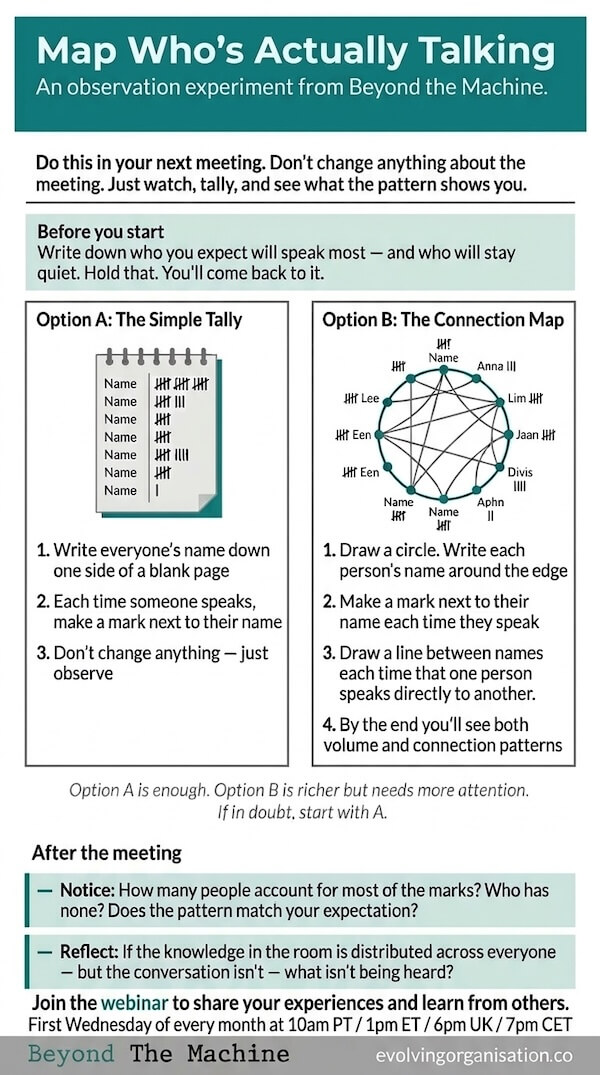
Choose one of two approaches, depending on how much you want to track:
Option A — The simple tally
Before the meeting starts, write the name of everyone present down one side of a blank page.
Each time someone speaks, make a small mark next to their name. Don't track what they say or how long they speak — just: who spoke.
Let the meeting run exactly as it would without you watching. Don't change anything.
Option B — The connection map (richer, but needs more attention)
Draw a circle on a blank page. Write the name of each person present around the edge, roughly where they're sitting.
Each time someone speaks, make a mark next to their name (same as Option A).
Each time someone directs a comment to a specific person, draw a line between those two names.
By the end, you'll have both a tally (who spoke how much) and a map (who spoke to whom). The lines show you where the connections are — and where they aren't.
Option A is enough. Option B gives you more to look at — but it requires more of your attention, which matters if you're also participating in the meeting. If in doubt, start with A.
That's it. One meeting. You're not committing to a new way of working — you're looking at a pattern that's been there all along.
Notice
After the meeting, look at the page. What you're seeing is the shape of your group's conversation — who's in it and who isn't.
Pay attention to the distribution. How many people account for most of the marks? Is there anyone with none, or just one or two? If you used the connection map, where are the lines concentrated — and where are there gaps? Does the actual pattern match the expectation you held at the start?
If you can, jot down a sentence or two straight afterwards. What you noticed will be clearer now than it will be tomorrow.
Make sense
Once you've had a chance to sit with it, ask yourself: If the knowledge and perspective in the room is distributed across everyone present — but the conversation isn't — what isn't being heard?
Whatever you noticed — expected or surprising, encouraging or uncomfortable — that's useful. The point isn't to get a particular result. It's to see something you hadn't seen before.
What next? If the pattern surprised you, try it again in a different meeting and see whether the same shape shows up. If it didn't — that's fine. Not every experiment fits every team. Either way, you've learned something about how your group works.
If you'd like to share what you noticed, we're collecting observations from everyone who tries these experiments as part of our research into what actually works when teams try to change how they operate. It takes about two minutes. Share what you noticed →
Curious what happens when the whole group sees the pattern? At the end of a meeting, ask each person to estimate what percentage of the talking they did, then share the numbers aloud. The gap between perception and reality usually generates the most interesting conversation of the day. Keep it light: a one-off observation, not an audit.
However this went — whether the pattern was stark or subtle, expected or surprising — you looked at something most teams never look at. That matters more than it sounds. Most groups operate with invisible dynamics shaping every conversation. You just made one of them visible.
Come and share what you noticed
We're running a live session on Wednesday 1 April where people who tried this experiment share what they observed, ask questions, and hear what others experienced. It's informal — bring your observations, your curiosity, or just come and listen. You don't need to have tried the experiment to join.
→ Register for the Practice Webinar here →
Going deeper
The practices in this series — Attention to the Whole, relational infrastructure, feedback — are part of what we work with in the Evolving Collective Leadership programme, co-developed with Amina Knowlan and drawn from the Matrix Leadership practices. The next cohort starts April 2026. And if you want a lighter-touch space to bring questions like these, Beyond the Machine: Live is a monthly drop-in for practitioners.