

#23 Metacrisis, Resilience & Thresholds- Part 1 When the Maps Run Out
Summary
Many of us are navigating something that doesn't quite fit the usual categories of stress, grief, or burnout — a sense that the maps we've relied on are giving less information than they used to, that the difficulty has taken on a quality our current tools weren't built for. This is the first in a series of articles exploring resilience not only as a personal capacity to be developed but as something that lives across five nested layers — from the deeply personal to the collective, the ecological, and the transpersonal. It introduces the Resilience Egg as a way of locating where support is needed and where something new might be trying to emerge.
In this article:
Before the next piece- three questions
Next week: what resilience has been carrying — and what it might be leaving out.
When the Maps Run Out
Underneath many of the conversations I'm having right now, it feels like tectonic plates of meaning are on the move.
Not dramatically. Nothing you could point to easily. But underground. I've been spending time with people who are doing good work — practitioners, facilitators, community organisers, people who are thoughtful, committed, and not naive — and I keep sensing a texture to the difficulty that wasn't there five or ten years ago.
For many of these people, the work itself is more sophisticated than it's ever been. They understand complexity. They're finding ways to work with it.
And yet. They're tired in a way that doesn't resolve with a rest. The maps they've trusted are giving them less information than before. And underneath the practical questions — how do we hold this much, how do we keep going, how do we make decisions that actually stay made — there's something that sounds less like a problem to solve and more like a question about orientation.
It's in specific moments. The exchange with a close friend where you both find yourselves saying I don't know about things you'd previously had a clear view on, and neither of you quite names what that shift is. The team planning session where someone asks about the one-year picture and there's a small pause before anyone answers — not from not knowing, but because the answer feels less certain than it used to. The Sunday evening that carries something heavier than next week's tasks. Not dread exactly. Something less perceptible: a low-grade awareness that the week ahead is somehow more than just the work in it.
Where are we?
I don't want to over-dramatise this. What I keep sensing, though — in conversation after conversation — is something about the ground underneath us. Or, the reliability of the frame we're working within.
The difficulty isn't primarily practical. The tools work. We have the skills to use them. What's becoming less adequate are the maps that help us feel like we know where we are and where we're going.
Part of why this has been so hard to name is that it's not coming from a single place. Economic instability, institutional erosion, the fracturing of social trust that used to feel load-bearing, ecological conditions arriving into contexts that weren't built to account for them, the deliberate disruption of political relationships previously assumed to be stable — these aren't separate stories. They're pressing at the same time, on the same people and the same organisations. The difficulty isn't that any one of these things has exceeded what people can handle. It's that they're arriving together, in combinations that exceed what most of our current operating logic was designed for.
There's a particular quality to this moment. On any given day, life is largely continuing as normal. There are invoices to send, schools to pick children up from, plans to make for the summer. The ordinary infrastructure of a life keeps running. And at the same time — not instead, and not sequentially — multiple systems are visibly unravelling. Economic, ecological, institutional, social. Each intersecting with the others in ways that amplify rather than cancel. The term that keeps appearing in the literature is metacrisis: not a collection of separate crises happening to arrive at the same time, but the compounding effect of their intersection, where the failure of one system undermines the capacity of others to absorb it.
Most of us are navigating all of this at once, all the time, without necessarily being able to put it into words. This isn't denial exactly, and it isn't compartmentalisation. It's more that the cognitive architecture most of us unconsciously rely on doesn't have room to hold all of this simultaneously — the meeting that needs preparing for and the backdrop against which it's happening. So we move between them. Attending to the ordinary. Being caught by the larger. Returning to the ordinary again. The dissonance isn't between knowing and not-knowing. It's between two things that are both fully real and won't resolve into a single coherent picture.
That's part of what makes this particular form of tiredness hard to name. It's not the tiredness of overwork, or of sustained difficulty, or even of grief — though it can contain all of those. It's partly the tiredness of holding two things at once, without a frame large enough to contain both, for longer than anyone was prepared for.
You see this strain in the decision a couple makes together about where to live — careful, well-considered, made in good faith — that still doesn't quite settle, because the ground kept shifting while they were making it (I'm in one of those couples.) In the plan a group of friends put together, with real intention, that kept needing revision, not because anyone had misjudged anything, but because the conditions it was built around weren't standing still.
This is where the work I've been exploring under the Beyond the Machine banner keeps arriving at the same question. The assumption that organisations are things to be engineered and optimised for predictable conditions — what I'd call the machine paradigm — isn't failing because it's been badly applied. It's meeting conditions it simply wasn't built for. And the approaches that keep emerging as more adequate — distributed authority, relational depth, developmental capacity — are starting to look less like progressive design preferences and more like practical necessities.
The resilience frameworks most of us inherited, personally and collectively, were built on a particular set of assumptions. That disruptions are temporary. That systems return to equilibrium once the disturbance passes. That the task is recovery: absorb the shock, find your footing, continue. Those frameworks weren't wrong. They matched the conditions they were built for. But when disruptions stop being discrete events and become something more like a continuous condition — when the equilibrium you're trying to return to never quite comes back — recovery starts asking you to do something it wasn't designed for.
I know people who've invested seriously in their own inner work, who know how to tend their psychological landscape, and who are finding that individual practice doesn't quite reach what they're up against. I know teams that are skilled at navigating difficulty together, and are finding the difficulty has taken on a quality that their team skills don't quite address. Someone put it to me recently as "trying to build shelter in the right place, but not quite being sure we've found the right place yet." The shelter is good. The location question keeps returning.
The skills aren't wrong. The map is missing some territory.
And to locate this in context: the conversation about what resilience means in conditions of structural rather than temporary disruption has been developing for some time — in Joanna Macy's decades of work on facing overwhelming crisis without collapsing into despair,¹ in Jem Bendell's Deep Adaptation framework,² and in the social-ecological systems research that has shaped how we understand nested living systems and how they absorb shocks.³ What follows tries to hold together what these (and others) have each been pointing at. It isn't a replacement for any of them.
When the maps run out, the instinct is to find a better one — a framework that works where the previous ones haven't. Sometimes that's exactly the right move. But sometimes what's being asked is something prior to that: a genuine reckoning with the fact that what's changed isn't something a new framework resolves. It's the conditions within which any framework operates.
Which is where the idea of a threshold becomes useful — not as a metaphor for hardship, but as a description of a particular kind of moment.
A threshold is where the stability that sustained the previous way of operating is gone, and forward movement requires accepting that the future will be different to the past. Not worse, necessarily. Different enough that the old maps stop serving as guides and start functioning as distractions.
The threshold isn't the disruption itself. It's the recognition that the disruption is structural rather than temporary — that what's gone isn't coming back, and something new needs to be built rather than the previous stability restored. That recognition is uncomfortable. It's also what makes movement possible.
A different kind of map
The Resilience Egg is a way to understand where those thresholds are currently presenting — at each layer of resilience, across many of our lives at once.
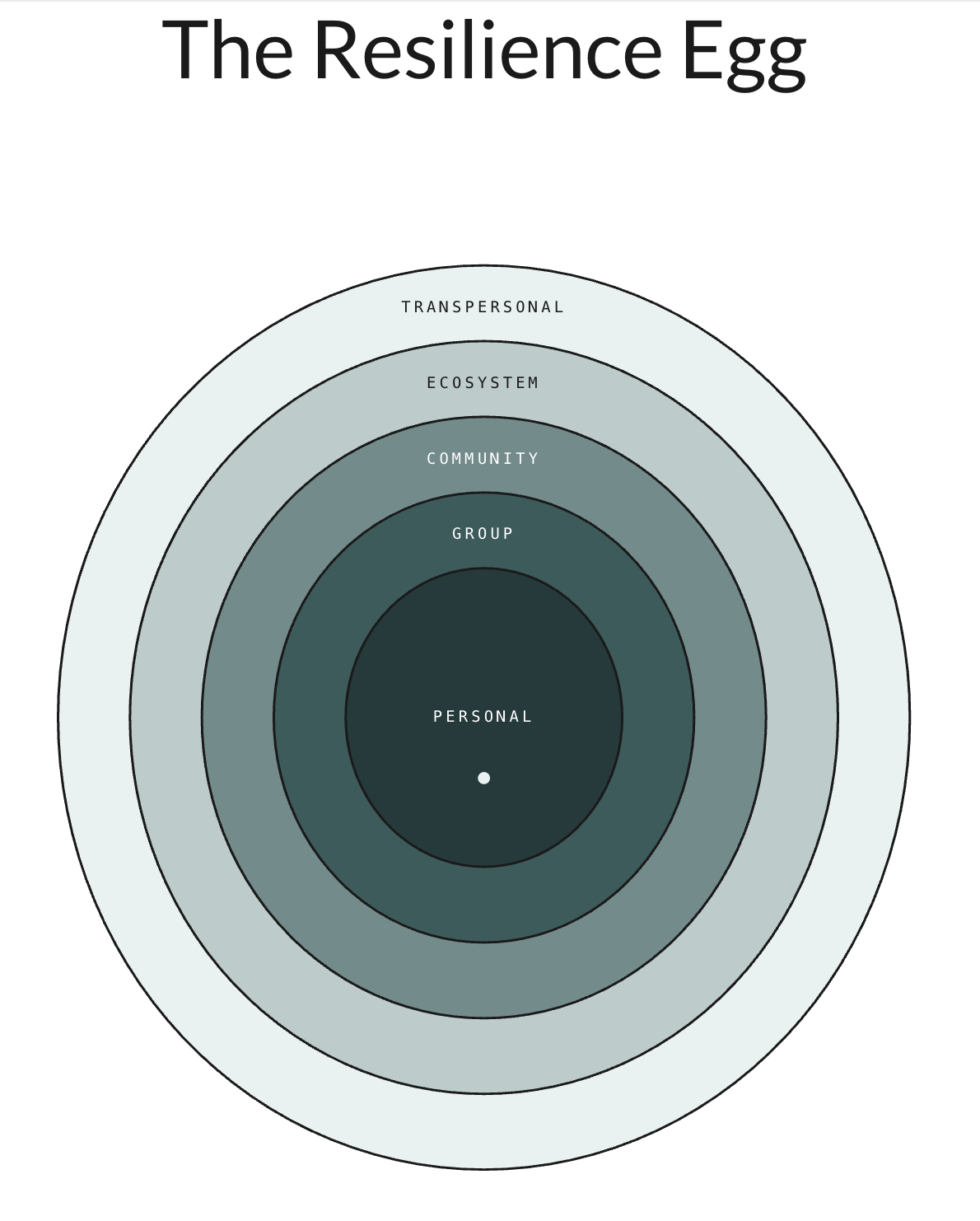
The name is deliberate. An egg isn't only a container. It's fertile and generative. These layers don't exist only to protect what's inside them; they create the conditions for something new to emerge. The question the Resilience Egg keeps opening isn't only how do we hold? It's what becomes possible when we're held by something larger than ourselves?
Five layers, nested: each one containing and depending on the others. At the centre, the personal — emotional and psychological. Moving outward: the group or team, then community, then the ecological, and at the outermost layer something that Justine Corrie (my wife and partner in this work) and I call the transpersonal — the resources of ancestry, archetype, ritual, and the kinds of knowing that don't belong to the individual alone.
Each layer gets its own article in this series. But before we go there: the most common gap in resilience work isn't that any single layer is weak. It's that effort concentrates in one layer while the others remain unattended. A team with genuine trust and psychological safety can still find itself overwhelmed — not because the relational work has failed, but because what's arriving from outside has exceeded what good internal process can navigate alone. A person with a serious inner practice can come back from the practice and find the same unsteadiness they left — not because the practice is wrong, but because what it's being asked to hold has outgrown what any single layer can carry.
These layers don't operate in isolation. A gap in community resilience creates a drain on group resilience. A depleted relationship with the ecological world erodes the sense of meaning that makes personal resilience sustainable over time. And the reverse: strength at one layer opens resources in the others.
The Resilience Egg isn't a model to master. Its job is simpler — to help you sense where support is needed, where strength might already be living that you haven't yet named, and what becomes possible when these layers are tended together rather than one at a time.
Before the next piece- three questions
Of the five layers — personal, group, community, ecological, transpersonal — which one feels most like home? Where do you naturally orient when things get hard?
And which feels furthest from where you are right now? Not the most intellectually unfamiliar. The one where, if you're honest, you sense the largest gap between what's needed and what's actually available.
And a third question, perhaps the most useful one: where do you sense a threshold? Not just a gap or a difficulty, but the specific feeling that the previous stability in this layer isn't coming back in the same form — that forward movement here requires accepting that, rather than working toward restoration.
Wherever that noticing lands, that's usually where the important work begins. You don't need to do anything with it yet. Just notice. We'll come back to it.
Next week: what resilience has been carrying — and what it might be leaving out.
This series connects to something we'll be working with in practice — across ten days, in community, on 107 acres in northern Sweden — this summer. If you want to see what the full Resilience Egg looks like as lived experience rather than theory, find out more at Meeting at the Threshold.
References and further reading
- ¹ Joanna Macy and Chris Johnstone, Active Hope: How to Face the Mess We're In with Unexpected Resilience and Creative Power (revised edition, 2022); Joanna Macy and Molly Young Brown, Coming Back to Life: The Updated Guide to the Work That Reconnects (2014). Joanna Macy died in July 2025 at the age of 96. The Work That Reconnects continues at workthatreconnects.org
- ² Jem Bendell, Breaking Together: A Freedom-Loving Response to Collapse (2023). The Deep Adaptation framework, first introduced in 2018, has evolved through several iterations and is now developed as the 6Rs. https://jembendell.com
- ³ The Resilience Alliance and the social-ecological systems lineage — foundational work on nested adaptive cycles (panarchy), and the distinction between robustness, adaptability, and transformability as different kinds of resilience capacity https://resalliance.org
- The Transition Movement — community-scale relocalisation and the inner and cultural dimensions of resilience work, founded by Rob Hopkins and others https://transitionnetwork.org
- Global Ecovillage Network, Ecovillage Resilience +2.5° — participatory research with 20 communities across 18 countries exploring resilience, adaptation and transformation (completed 2024). Now evolving into the Keystone Communities project, working with 85 practitioners across 49 communities in 28 countries. https://ecovillage.org
- Vanessa Machado de Oliveira, Hospicing Modernity: Facing Humanity's Wrongs and the Implications for Social Activism (2021). https://decolonialfutures.net
- Bayo Akomolafe, These Wilds Beyond Our Fences: Letters to My Daughter on Humanity's Search for Home (2017), and the Emergence Network. https://bayoakomolafe.net
- Post Carbon Institute — The Community Resilience Reader and the Six Foundations for Building Community Resilience. https://resilience.org
- Leading Through Storms — practitioner work on leadership in conditions of polycrisis. https://leadingthroughstorms.org


