

#24 Metacrisis, Resilience & Thresholds- Part 2 Bouncing Back Isn't the Point
Quick Summary
Most of us have been working from a particular model of resilience without quite naming it: absorb the difficulty, recover, return. It's a reasonable model, and it's been useful in some ways. But there's a growing sense — in people who've been through enough, or who are paying close enough attention to what's actually happening — that returning isn't quite it anymore. This piece works through three ways of understanding resilience, and finds that the one most of us have been aiming for still isn't the thing.
In this article:
Is Bouncing Back Enough?
There's a word that's been circulating for a while now, carrying more weight than it can comfortably bear.
Resilience. You hear it everywhere. In team off-sites, in wellness programmes, in leadership development curricula. Sometimes it appears as a verb — build resilience — as if it were a competency like project management, something you could add to your repertoire and tick off. And somewhere in all of that use, the concept has picked up so many different meanings that it's worth pausing to ask what we're actually talking about when we use it.
Because the version most of us have been working from — the default model, the one built into most coaching, most organisational culture work, most of what gets described as resilience training — rests on a particular image. A spring. Compressed, released, returning to its original shape. Bounce back.
The spring metaphor feels intuitive because it maps onto a real experience. You go through something hard. You recover. You find your footing again. There's something true in that, and I don't want to dismiss it, because return is sometimes exactly what's needed. Coming back to yourself after a period of sustained difficulty is a real and valuable thing.
The problem isn't with return. The problem is with what the spring image treats as given.
It assumes that the self that returns is the self that should return. That the disruption was an interruption to a state worth restoring. That the job is to absorb the impact and get back to normal. And in a world where disruptions are discrete, temporary, and the equilibrium on the other side is stable and recognisable, that's a functional model.
We're not in that world right now. But even before we get to the metacrisis and the colliding systems — all of which I wrote about in the previous piece — there's something limiting about the bounce-back model that operates at a much more personal level. It treats the disruption as signal-free. Something to get through rather than something to read. The spring doesn't learn anything from being compressed. It just returns.
Resilience as Bouncing Forward
So we moved, as a field, toward a more sophisticated framing of resilience as a concept. Post-traumatic growth. Bouncing forward.
The idea is appealing, and it's an improvement. Rather than returning to your prior state, you use the difficulty as a catalyst — emerge changed, more capable, more adaptive. The disruption teaches you something. You grow through it rather than despite it. Most personal development and leadership resilience work now operates from something in this neighbourhood, and it's better than the spring. It takes seriously that something changed.
The limitation is more subtle, and I've had to work it through myself to see it clearly.
Bounce forward is still fundamentally a story about the individual's trajectory. It asks: what did this experience make you capable of? It keeps the lens on you — the returner, now improved. The disruption is still an event that happened to you, still something to navigate and integrate and, in the best case, to grow from.
What remains outside the frame is the web you're part of. The relational field you inhabit, the collective conditions that made the disruption likely in the first place, the others who were part of the same difficulty and are on their own bounce-forward trajectories — none of this appears in the model. A more capable you re-enters a system that hasn't been examined.
There's something worth pausing on here, because the bounce-forward model is deeply aligned with the values many of us hold: growth, adaptation, the belief that experience shapes us. The turn I'm making isn't a critique of those values. It's that there's a version of resilience that those values haven't yet reached.
Bouncing Outward
Drawing on the work of Chris Johnstone (1), at the Bjärkan Resilience Project, our aspiration is built around a third way of framing the idea of Resilience: bouncing outward.
Not a return to yourself, improved or otherwise. Not even a cleaner, more capable version of the prior self re-engaging with the same world. Something different in its basic orientation: the encounter with difficulty as a way of becoming more porous to the larger web of connections you're part of.
This is where I have to be careful, because it's easy to make this sound like a virtue instruction — be less self-focused, pay attention to the collective — and that's not what I mean. The shift isn't moral. It's perceptual.
What I've seen happen, in the work and in myself, is this: certain encounters with difficulty — the kind where the usual tools don't quite reach, where the scale is too large or the uncertainty too sustained — begin to soften the membrane between the isolated self and the larger system it's embedded in. Not immediately. Not without friction. But over time, something that was experienced as happening to me starts to be experienced as moving through the system I'm part of. The difficulty becomes legible at a different scale.
When that happens, the question changes. It's no longer only how do I recover, how do I grow? It becomes something more like: what is this difficulty revealing about the larger web? And what becomes possible when I work from there rather than from the isolated self trying to return or advance?
One participant from the 2024 training put it this way — and I'm paraphrasing, not quoting:
the quality of being actually present, without anything else competing for attention, felt like a different relationship with difficulty itself. Not the absence of it. A different orientation to it. Something that belonged less to managing the difficulty and more to inhabiting the moment fully enough that the difficulty stops being something to get past.
That's close to what the third frame is pointing at. Not a technique for becoming more resilient. A change in what resilience is for.
Personal Resilience is Necessary But Not Sufficient
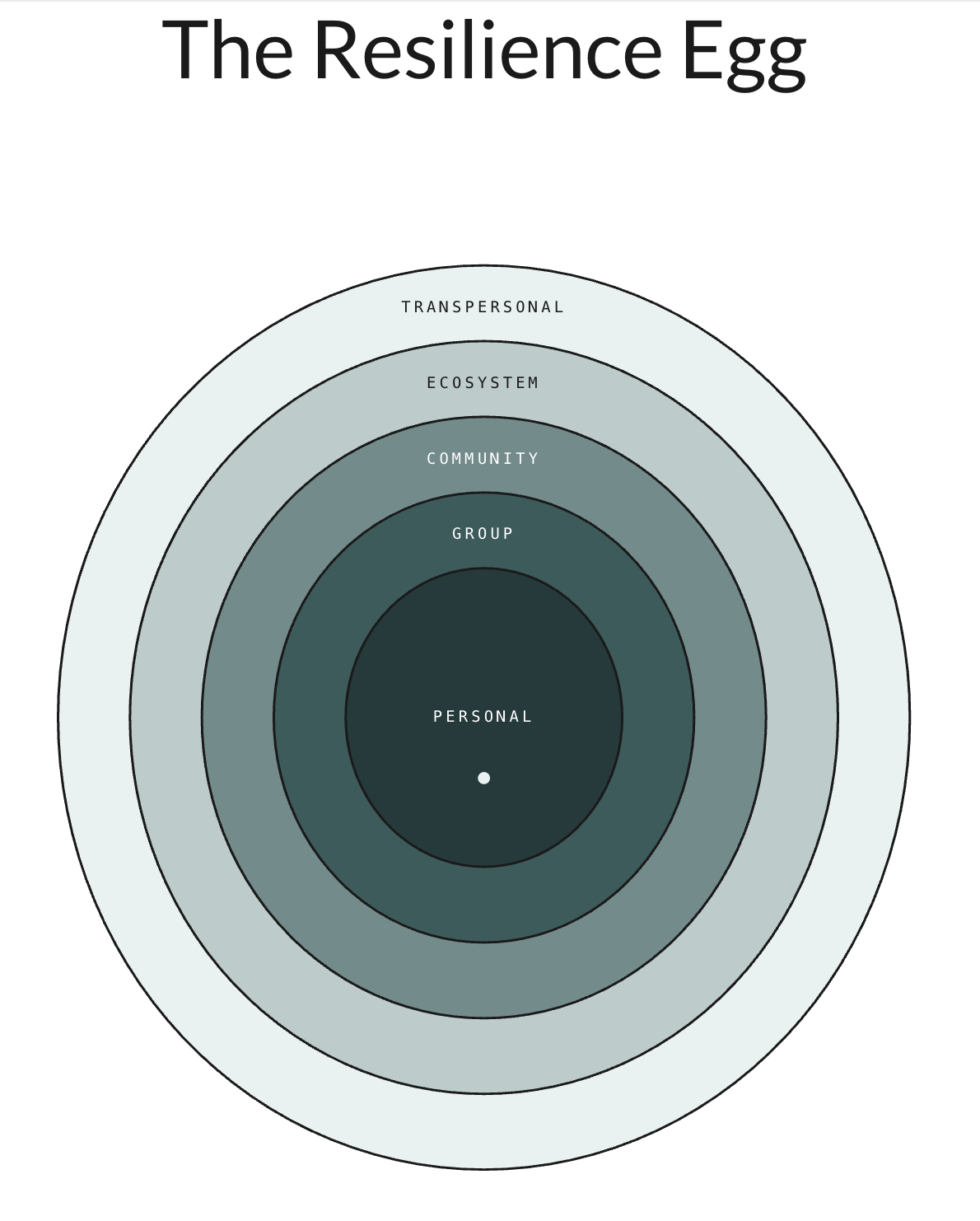
The nested egg model — which the full series is working through — places personal resilience at the centre. But it matters that it's the centre, not the whole. Every outer layer (Group, Community, Ecosystem, Transpersonal) is simultaneously holding it. Personal resilience work that doesn't eventually extend outward isn't wrong. It's self-referential in a way that mirrors the very pattern it's trying to address: the isolated self trying to manage, adapt, and become more capable, while the web of relationships that might actually transform the conditions remains unexamined.
The discomfort I want to leave with you here isn't about the work you've already done — on yourself, on your practice, on your capacity to navigate difficulty. That work matters. The discomfort is about what frame you've been using to locate it.
Bounce back asked: can you return? Bounce forward asked: can you emerge stronger? Both are reasonable questions. Bouncing outward asks something less comfortable: what would it mean to let this difficulty reorient you toward something larger than your own recovery?
What would it mean for you if resilience wasn't a return — not even an improved return — but a fundamental reorientation?
The Meeting at the Threshold event in Sweden in July is designed around all three framings — especially the third. bjarkan.org/meetingatthethreshold
Next week: the thing that makes reorientation almost impossible for most of us.
A note before I close this piece: I've been deliberately working through these framings in order, and I don't think any of them are without value. The point isn't to graduate from bounce-back to bounce-forward to bounce-outward as if it were a development path. The point is to notice which one you've been unconsciously using as the default — and whether it's doing the work you need it to do.
References
1- Chris Johnstone, Book 7 Ways to Build Resilience at https://chrisjohnstone.info/books


