#13 The Essential Components of Collective Leadership
By Amina Knowlan of the Matrix Leadership Institute
Quick Summary
In this second article of the series, I unpack what collective leadership actually requires in practice. Building on the premise that living systems need both connection and differentiation, I detail six foundational practices that shift leadership from being located in individuals to emerging from the interactions of all members. Three practices create sustainable connection: person-to-person communication, cultivating a ground of health, and attention to the whole. Three advanced practices support healthy differentiation: engaging with differences as resources, building a high-feedback culture, and distributing leadership roles across the group. When these capacities are in place, teams become living, breathing organisms characterized by extraordinary engagement and belonging—with care and respect as the sustaining atmosphere.
Here's what's included:
The Need for Collective Leadership
REQUIREMENT #1: The Parts Must Be CONNECTED TO Each Other
1. Person-to-Person Communication
REQUIREMENT #2: The Parts Must Be DIFFERENTIATED FROM Each Other
5. Giving and Receiving Appreciative and Differentiating Feedback
6. Identify, Differentiate from, and Distribute Group & Leadership Roles
The Need for Collective Leadership
If you’re reading this, you have some sense that collective leadership must replace strictly hierarchical and authoritarian or siloed leadership. You may even have the ‘heads up’ that relationships (connections) become centrally important. You may have direct experience that most teams and professional, family and community relationships break down because of challenging or even dysfunctional ‘interpersonal’ dynamics.
Families, teams, organizations and communities all suffer from relationships that become fractured and polarized, contributing to our epidemic of power held by the few, social isolation and divisiveness. Never has the imperative to “go forward together” been more crucial. Now more than ever, we must move beyond the myth of the Lone Ranger and the consciousness of power and privilege (held by the few).
The era of individualism–even the ‘myth of the individual’ must evolve into the era of 'by and for the whole’. Collective leadership yields functional interconnection which enables teams to operate as self-managed (living) systems, and supports the well-being, sustainability and growth of all of us. It is the road home.
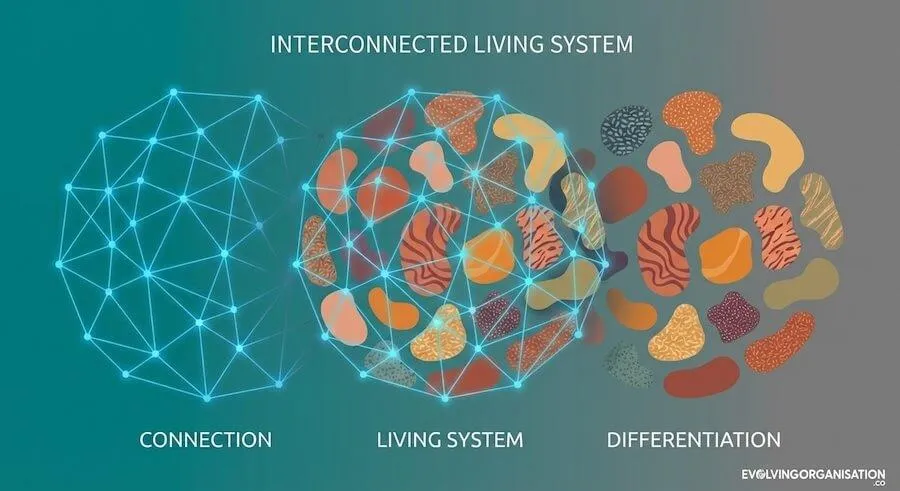
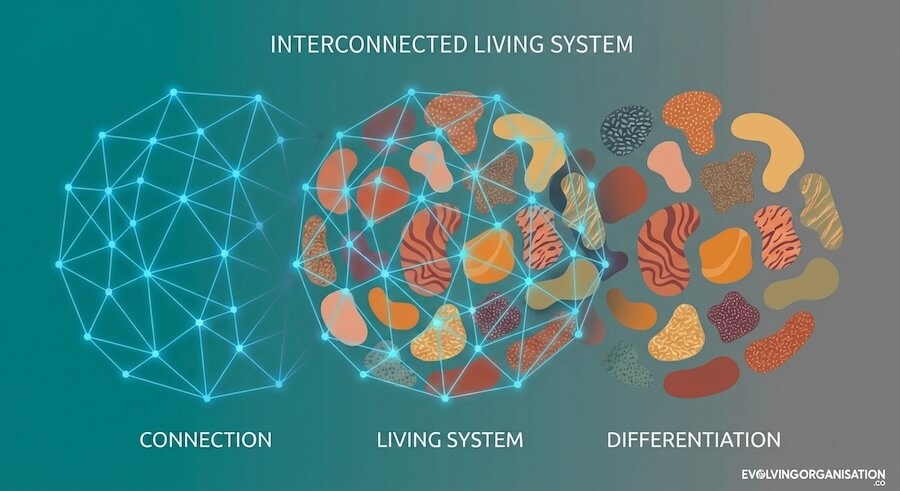
In my first article in this series, Shifting Beyond Hierarchy Means Moving from Control to Connection, I stated that there are two fundamental requirements for a team or organization to function as an interconnected, living system.
First, the parts must be connected to each other.
Secondly, the parts must be differentiated from each other.
What makes leadership truly collective is not simply about deciding together--seeking agreement like collaborative leadership. Rather, it's about generating new insights and direction from bringing differences together, exploring them with curiosity while staying in connection. Leadership then emerges synergistically from the collective interactions of all members as they generate a wisdom that's genuinely greater than the sum of individual contributions.
In this article, I build on this premise to unpack these two requirements of collective leadership in action–the practices and related norms that need to be adapted. Let me walk you through six foundational and advanced practices that bring this to life—three that create connection, and three that support healthy differentiation.
REQUIREMENT #1: The Parts Must Be CONNECTED TO Each Other
Three foundational practices that support connection:
1. Person-to-Person Communication
Relationships and the capacity to communicate peer-to-peer (person-to-person) have to be intentionally developed. Talk directly to each other ’in the ‘open’ – in the group – directly establishes a connection – a communication channel – between each pair of people in the group. This is crucial and foundational to fostering every other capacity of living systems and collective leadership.
2. Ground of Health
We also need to cultivate these relationships with trust, positivity, appreciation, psychological safety, resilience and yes, love– to develop the capacity to stay connected and thrive over time. Examples of intentionally starting a meeting or discussion with topics that establish a ground of health include
Building on strengths. What’s going well? What talents do you bring to this project?
What lights you up outside of work? What keeps you inspired? What keeps you connected to something greater?
Learning about our similarities and affinities; getting to know each other as fellow human beings.
3. Attention to the Whole
Everyone becomes responsible for the tracking and intervening to create more inclusion and engagement, including monitoring their own participation. We encourage all members to cultivate the awareness (and value of) noticing the patterns of communication (the who, when, how, how long).
Who is included in the conversation, who is woven into the ‘whole’ and who is not?
Which individuals or interactions create dominance or exclusion, or limit the collective intelligence? E.g., who speaks most often, or too long for the time allotted? Whose voice is not included or is marginalized? When does a discussion stay within a particular subgroup (e.g., the men, the most senior members)?
In human systems (groups, teams, families, organizations, communities), in order for the ‘parts’ to be connected, many of our communication and leadership norms have to change from ones that conceive of leadership as an individual, and often competitive, phenomenon to one that is collective and relational: leadership literally emerges from the interactions of the members.
REQUIREMENT #2: The Parts Must Be DIFFERENTIATED FROM Each Other
Three advanced practices that support differentiation:
4. Engage with Differences
Individuals need to be supported to express their unique (and different) perspectives, intelligence, gifts and cultures. No system - whether family, team, classroom, organization or community - can access its full intelligence and wisdom without the benefit of their extensive differences. We establish new cultural and communication norms that shift from relating to differences as threats (power struggles, conflict, either-or, good-bad) → to → resources (value-add, ++) essential to the well-being, sustainability and growth of the ‘whole’.
5. Giving and Receiving Appreciative and Differentiating Feedback
Peer-to-peer feedback given in the group - at least part of the time - is essential to mitigate the impact of power-over, authority dynamics, unconscious bias and differences that are marginalized. A high feedback culture, established with psychological safety, builds engagement and ownership; accelerates learning, growth, innovation, buy-in and accountability. We must redefine our whole culture around feedback which is typically experienced as “critical” or “top-down” to something that is
An investment in our relationships, the work/life we have together and the outcomes we generate together
Just data about the impact of one person’s behavior on another. It is NOT the ‘truth’ about who the person is or what happened
An opportunity to align our intention with our impact
A path to differentiating from that which doesn’t serve the relationship or our work and life
Appreciative! Aspire to a 5:1 ratio
6. Identify, Differentiate from, and Distribute Group & Leadership Roles
Identifying group roles that have become habitual, stale or limiting is key to collective leadership. Roles are behaviors and functions expressed or performed on behalf of the whole (family, team, group, organization). This includes perspectives or emotional fields that are expressed primarily by one person or pair. Once recognized, we work to differentiate from those habitual expressions and functions to distribute them through more individuals or subgroups. Collective intelligence is exponentially increased when more versions (expressed by more individuals) are included. Individuals are liberated from patterns that are habitual or burdensome - and - increase their range of choiceful behaviors and expression. The status quo is disrupted –while the members’ connections are maintained making way for the NEW adaptive, innovative, and emergent wisdom.
#’s 5 and 6 are additional components and practices that are both cultural game-changers. They might be thought of as moving from developing the foundational skills in a sport or in playing an instrument, to functioning as a highly responsive team or as a brilliant symphony or jazz band.
What this Means for Collective Leadership
With these capacities in place– groups of all kinds have the foundation to be ‘led’ by the interactions of all of the members. Individuals bring their full self, feel seen, valued and a part of something greater that also supports their growth and development. Groups truly become living, breathing, fluid, stable and resilient ‘organisms’ whose collective intelligence and wisdom are informed by the Whole that is greater than the sum of the parts. Groups and teams are characterized by extraordinary engagement and belonging.
So, rather than being thought of as being located in individuals, leadership becomes relational, connection is primary, and creative utilization of our unique differences is the gold. When these practices become embedded, something shifts. The ground beneath our work becomes one of care, respect, and appropriate emotional connection—what we might call love in its essential, non-romantic sense. This becomes the atmosphere that sustains the whole.
Where does this land in your own team? I'd like to hear what's working around these themes and what isn't, in your own words. It takes about five minutes, your email is optional, and what you tell us shapes what we write next and feeds the book we're building from the field. Share what's working and what isn't.
🪧 Signpost to Find Out More
These six practices form the core Matrix Leadership model from the Matrix Leadership Institute. To find out more about how to shift the leadership in your group/team/organization beyond individuals in a hierarchy and into a collective leadership, check out our:
Evolving Collective Leadership training program - Our online training program that guides you through developing these skills, step by step.
Matrix Essentials: building groups & teams as living systems - An immersive residential training this summer in northern Sweden, where you'll experience these principles as a living system in the wilderness.