#30 EXPERIMENT: Try it: Withdraw one unit of consent
In a meeting someone asks who can take something on, and there’s silence. How long before you fill it? In my case, it used to be less than a second. Not any more.
In last week’s Beyond The Machine article, Stewarding Ourselves at the Edge of Hierarchy, Jan de Man Lapidoth asked whether better leadership is really the answer to work that leaves people drained. He offers stewardship instead: acting as part of the system rather than standing above it. Part of this shift, he suggests, includes withdrawing your consent, bit by bit, from habits you keep feeding after you’ve stopped believing in them. His own example was a written promise to his board. For most of us it shows up in smaller moments, like volunteering straight away, or smoothing over discomfort before it has a chance to say anything useful.
This experiment starts in one of those moments. It gives you a way to test withdrawing consent with one small act in a situation you’re already in. It takes less than a minute, and you can try it the next time the pull to step in appears.
The question: What happens — in you and in the situation — when you don't automatically fill the space that's expecting you to fill it?
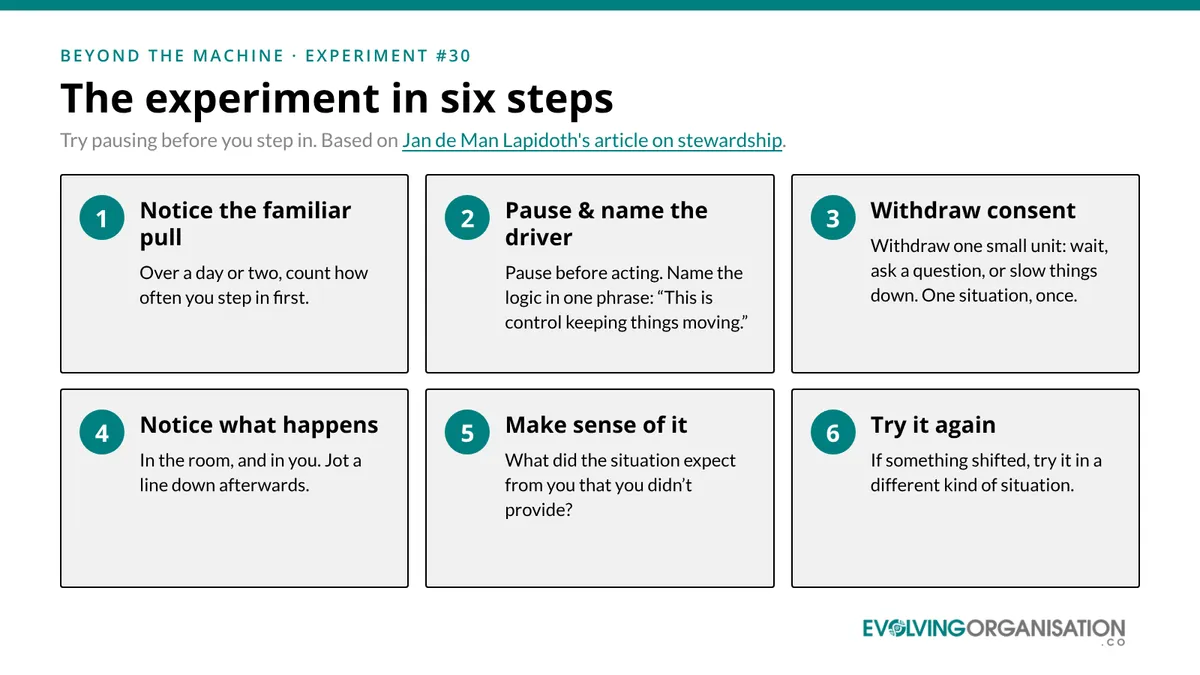
1. Notice the familiar pull
When to try it: The next time you notice the familiar pull to step in, take charge, decide, or comply in a way that feels automatic rather than chosen. This might be in a meeting, a conversation, a moment when someone brings something to you that feels like a request for rescue.
Before you try it, just notice one thing: over the next day or two, pay attention to how often the pull appears. You're not doing anything about it yet — just counting. Most people find it happens more often than they expected.
2. Pause & name the driver
When the pull arrives, pause before acting on it.
Name — silently — the logic driving it. You don't need the exactly right words. Something like: this is control keeping things moving. This is my competence being used to stabilise something fragile. This is performance over presence. One phrase, internal, enough to make the invisible visible for a moment.
3. Withdraw consent
Then, withdraw one small unit of consent. This might look like not volunteering immediately and waiting to see what happens. It might be asking a genuine question rather than offering your answer. It might be slowing the pace of a conversation rather than resolving it. It might simply be staying present without stepping into a leadership role you weren't asked to take.
The gesture can be subtle. What matters is that it's deliberate.
That's it. One situation. You're not committing to a new way of working — you're trying one thing once.
4. Notice what happens
During and immediately after, pay attention to two things: what happens in the situation when you don't fill the expected space — does someone else move? does nothing happen? does the conversation change tone? — and what arises in you. Not an evaluation of whether it went well, but the specific feeling that follows: relief, guilt, irritation, fear, something harder to name.
If you can, jot a sentence or two down straight afterwards. What you noticed will be clearer now than it will be tomorrow.
5. Make sense of it
Once you've had a chance to sit with it, ask yourself: what did the situation expect from you that you didn't provide? And what happened in the space you left?
Whatever you noticed — expected or surprising, encouraging or uncomfortable — that's useful. The point isn't to get a particular result. It's to see something you hadn't seen before, break a pattern and see what novelty emerges.
6. Try it again
If something shifted, try it again in a different kind of situation. If nothing landed, that's fine — not every experiment fits every context. Either way, you've made something visible that was previously running on automatic.
If you'd like to share what you noticed, we're collecting observations from everyone who tries these experiments as part of the Beyond the Machine research into what actually changes when people stop feeding what they no longer believe in. It takes about two minutes. Share what you noticed →
Trying this as a team
If you want to try this with your whole team rather than on your own, keep it simple. At the start of your next meeting, name it briefly — something like: "I've been experimenting with pausing before I step in automatically. I'm going to try it in this meeting — feel free to do the same." Frame it as a personal trial, not a team protocol. That's an easier yes, and it leaves others free to notice their own version of the pull without performing anything for each other.
We're running a live session on November 5 where people who tried this experiment can share what they noticed. It's informal — bring your observations, your questions, or just your curiosity. You don't need to have tried the experiment to join. Register here →