
#14 How Our Personal Shadows Secretly Sabotage Self-Managing Teams (Part 1 of 3)
By Kenny-Whitelaw Jones & Nick Osborne
Quick Summary
Why do teams keep recreating the very hierarchies they're trying to leave behind? This article introduces the idea that our psychological "shadow" — the emotions, fears and impulses we've learned to hide — silently shapes how we relate to power, authority and each other at work. Using Carl Jung's concept of shadow and projection, we explore how suppressed fears and unspoken judgements can undermine even the best-designed self-managing structures. It's the first in a three-part series that moves from individual shadow, through relationship dynamics, to practical experiments you can try in your own team.
Contents
Introduction to the 3-part series
This three‑part series explores how our psychological shadows can work against moving organisations beyond hierarchy.
In this first part, we introduce the concept of the shadow and look at how it shows up in the workplace. Part 2 zooms out to look at how the shadow plays out in workplace relationships. Part 3 examines organisational shadows and provides some practical approaches to working with them so that post-hierarchical ways of working with power and authority can truly take root.
Taken together, these three articles offer a way to see and shift the dynamics that often lurk beneath the surface of “culture change”. We’ll explore how projections and relational patterns keep hierarchy in place even when we say we want shared power.
These articles include practical language for naming what we often sense but cannot describe. They will conclude with a concrete experiment you can do, and small changes you can try in your own teams. You’ll learn how to test new ways of relating, decision‑making and feedback in real time, and discover for yourself how to create connected, self‑managing and resilient systems.
How our unexamined inner world keeps hierarchy alive
When organisations try to move beyond hierarchy, they often discover the same paradox:
We want shared power... but we keep recreating control.
We want empowerment... but we cling to safety.
We want self-managing teams... but we defer to legacy authority.
It is tempting to think that moving beyond old top-down models of command and control is just about changing structures of concentrated authority. What we’ve seen, however, is that even when teams adopt new governance processes or role-based systems, if the shadow dynamics within the organisation are unexplored, under pressure people are likely to slip back into old familiar habits. Things like corridor deals, private escalation to senior leaders, and decisions made “off the books”. This might look like a leadership team announcing a move to “distributed authority”, but in meetings everyone still looks to the CEO for approval before deciding anything. The structure has changed, but the inner pull toward “the parent in the room” has not.
In her 3-part series ‘Why We Can’t Let Go of Control’, Elenor Weistroffer explored how outdated assumptions about human nature sabotage the shift beyond hierarchy. This series explores the same phenomenon from a different angle: the structures and power patterns in our teams and organisations are in large part an expression of our inner emotional world and historical/familial patterns. The hierarchy lives in all of us. It’s the inner manager who needs to be in control, the inner child who wants to be rescued, the inner rebel who refuses any constraint. When a team starts experimenting with self-managing practices, these inner figures influence who grabs power, who avoids it, and who complains about it from the sidelines. In his article ‘How I Discovered My Inner Dictator’, Nick Osborne shares a vulnerable story about his own inner investigations in relation to this.
The truth is that we all carry shadows: those parts of ourselves that we hide, deny, or disown. Those shadow parts shape how we lead, follow, collaborate, protect ourselves, and build systems. During transitions beyond hierarchy, this might look like a founder who insists he “just wants to empower the team”, while repeatedly overruling decisions that make him anxious, or a senior manager who champions “consent-based decision-making” but still uses performance reviews to punish people who challenge her.
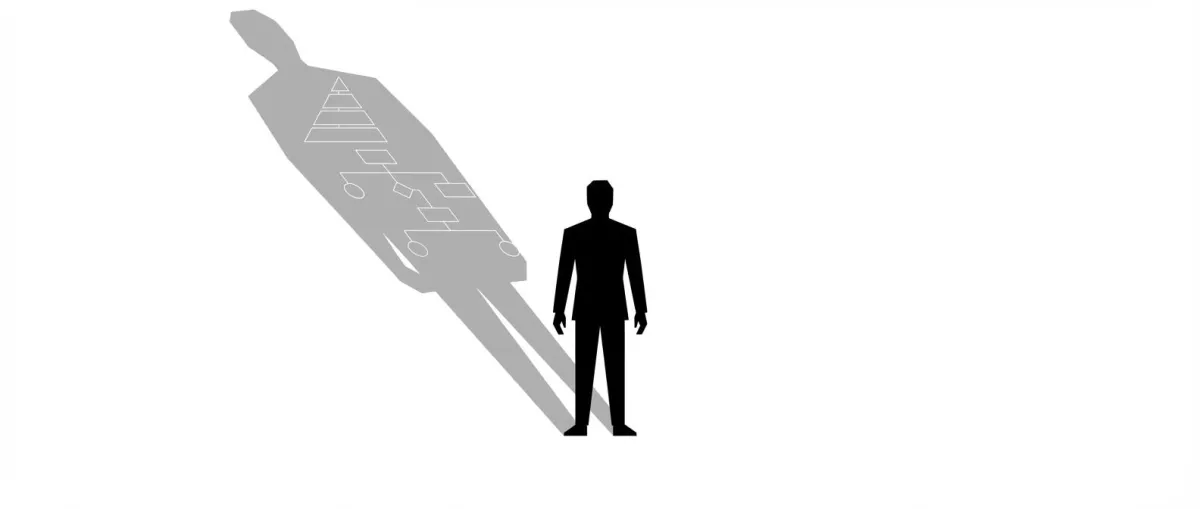
This is a deliberately simple introduction to psychological shadow and projection—just enough of the basics to see how they show up at work and how they can interfere with attempts to move toward more post‑hierarchical, self‑managing ways of working. Until we learn to work with the shadow, and own what was previously denied, attempts at organisational redesign to move beyond hierarchy will eventually and inadvertently recreate old hierarchical structures. Leaders introduce circles, roles, or agile squads, but unspoken loyalties, historic grievances, and unacknowledged fears quietly rebuild a shadow power structure of the old pyramid inside the new model.
The shadow at work
First described by Carl Jung, the “shadow” refers to the emotions, traits, impulses and memories we push out of sight because we learned from a young age that they were unacceptable.
By the time we get to the workplace, we are all carrying shadows - parts of ourselves we don’t want to own. Jung described the shadow as “The person we are trying not to be” and it shows up in many different workplace dynamics:
We bury our fear by trying to control everything.
We bury our anger by being “nice”.
We bury our vulnerability by “being professional”.
We bury our ambition by judging it in others.
We bury our neediness by pretending we are self-sufficient.
In a shift to self-managing teams, this might look like:
A long-time department head who cannot admit feeling lost without clear top-down authority, so doubles down on detailed tracking spreadsheets and escalations “for visibility”, effectively recentralising decisions.
A team member who resents past micromanagement but never voiced it, now responding to any new governance proposal as “more control”, trying to block needed structure in the name of freedom.
In both cases, suppressed fear and anger remain underground while the organisation experiences the surface behaviours: “controlling manager” or “difficult colleague”. Without naming the shadow – the fear of being unnecessary, the hurt of not being trusted – it becomes almost impossible to design roles, accountabilities, or decision pathways that people actually use.
If we look at the group as an interconnected system, we can see how shadows are experienced collectively, even when they are never named. In a meeting, you can often sense when someone is holding back a strong reaction, or when the room goes quiet around a particular person or topic. That ‘atmosphere’ is not just mood; it is the shared field of shadow and history, subtly guiding who feels safe to speak from their role and who silently defers to unspoken power.
How projection shows us what’s in shadow
By their very nature, our shadow parts are hidden to us. Despite being unseen, they influence us in unconscious ways. Jung said, “Until you make the unconscious conscious, it will direct your life and you will call it fate”.
There are some reliable ways to begin to uncover our shadow parts. Projection is one such way. Projection is what happens when we judge in others what we cannot tolerate in ourselves. It is the shadow’s favourite defence mechanism and it’s ubiquitous in the workplace. Looking at what we project onto others gives us clues about what lurks in our own shadow:
The anger we cannot feel becomes “their hostility”.
The insecurity we suppress becomes “their incompetence”.
The need for recognition we deny becomes “their arrogance”.
The power we fear becomes “their dominance”.
During a transition to new ways of working beyond hierarchy, projection might sound like:
“The new governance model is too controlling,” from a person who has never practised saying no or setting boundaries directly and is now experiencing new explicit rules as an attack on their freedom.
“People just want to avoid responsibility,” from a team member who privately feels overwhelmed, and secretly wishes someone would tell them exactly what to do.
Projection has very little to do with the person being judged; it is simply that the other person is holding up a mirror to what we cannot own in ourselves. When teams start experimenting with distributed authority, this mirror effect intensifies. When roles and decision rights are made explicit, people have fewer opportunities to hide their discomfort with power, conflict, or visibility.
The workplace is full of mirrors. In a redesign, every new role, meeting format, or decision rule becomes a screen onto which hopes and fears get projected: “this new process will finally fix everything” or “this new process is just another way to control us”.
Looking again at the group as an interconnected system, projections do not just move from one person to another; they travel along the lines of relationship. One person’s unspoken judgment becomes a story shared with a colleague over coffee, then a whispered “everyone knows they’re like that”, until a whole team relates to another team through a projected lens. The field between those groups thickens with assumption and mistrust, making it much harder for any individual to show up in a new way, even if they personally have done a lot of self-awareness work.
So what?
Before changing structures, it helps to see how your own shadow and projections are showing up in everyday reactions, relationships and decisions.
Projections take the form of judgements we make about a person or group and often sound like
“They are too…..[fill in the blank]”.
This person is too brash, too slow, too reckless, too ambitious, too controlling.
In the next article in the series, we’ll move on to apply what we’ve learned about the shadow and projections to workplace relationships.
Then we'll provide an experiment as a low‑risk way to turn these ideas into lived experience. By noticing your “They are too…” reactions in real time, you can sense for yourself whether this inner work opens up even a little more freedom, clarity and choice in how you relate to others and use power in your team or organisation.
Where does this land in your own team? I'd like to hear what's working around these themes and what isn't, in your own words. It takes about five minutes, your email is optional, and what you tell us shapes what we write next and feeds the book we're building from the field. Share what's working and what isn't.

