
#20 Relational Shadows in the Shift Beyond Hierarchy (2 of 3)
Quick Summary
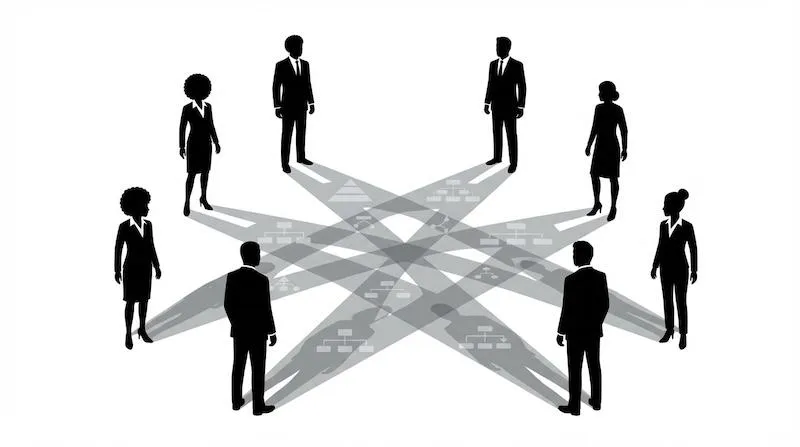
Projection doesn't stay personal for long. In this article, we trace how individual shadow — introduced in Part 1 — moves into the space between people: the colleague who triggers an outsized reaction, the department cast as the enemy, the leader placed on a pedestal. We explore five common projection patterns that surface during transitions beyond hierarchy, offer a field perspective on how each shows up systemically, and introduce four archetypes from Deep Process Psychotherapy as a shared language for understanding what's happening beneath the surface. The through-line: until these dynamics are named, no amount of structural redesign delivers the empowerment it promises.
In this article:
How the shadow shows up in work relationships
Blaming instead of self-reflecting
Turning conflict into morality
To work beyond hierarchy, we must reclaim our projections
Archetypes: a map for understanding shadow at work
How the shadow shows up in work relationships
In the previous article in this series (#14 How Our Personal Shadows Secretly Sabotage Self-Managing Teams), we introduced the ways that our personal shadows cause to us project our unowned parts onto other people. Projection fuels many of the challenges organisations wrongly attribute to “culture” or “people problems”. In transitions beyond hierarchy, some particularly common patterns show up.
Overreacting to a colleague
If you are feeling an outsized emotional response to someone’s behaviour, often, they are embodying something you have disowned.
Jack (not his real name) was a manager in a newly self-organising product team. On paper, the team had agreed that each role can act autonomously within its defined role purpose and authority, without checking with the team. However Jack finds himself becoming angry when a colleague takes initiative without checking in with the group. Jack experienced such acts as “reckless” or “disrespectful”. Underneath, he has exiled his own desire to act boldly, having learned earlier in his career, and further back also in his family, that “stepping out of line” gets punished. So now Jack attacks in others what he cannot yet allow in himself.
For leaders, noticing who triggers the strongest reactions during, for example Holacracy governance or tactical meetings, is often a direct route to their own shadow. The “too loud” colleague might be carrying the assertiveness they avoid; the “too sensitive” colleague might be holding the emotional intelligence they downplay.
Field perspective: It is also useful to notice how the rest of the group responds when projection is causing strong emotional reactions. If everyone else leans back, looks down, or mentally checks out whenever such an interaction occurs, the system is sending a signal: “we do not know how to hold this tension together”. In a healthy, interconnected field, others feel able to stay present, ask clarifying questions, and let the tension move through the group rather than being pushed back onto just two people.
Demonising a department
“That team is always difficult.”
“That group is so political.”
This is projection at scale and a precursor to collective shadow. During an operating model change, a central HR or Finance team is often cast as “the blockers”, while product or country teams see themselves as “the innovators”. Each side projects its shadow:
The central team disowns its own desire for creativity and risk, and so imagines the product teams as “chaotic” and “irresponsible”.
The product teams disown their own need for structure and limits, so experience any boundary from the centre as “control” or “punishment”.
Without surfacing these projections, redesign conversations get stuck at the level of slogans: “more empowerment” versus “more alignment”. Leaders then tweak org charts repeatedly while the underlying polarisation – freedom versus safety – never gets addressed.
Field perspective: from a whole-system view, it can help to map who is connected to whom, and where conversations about tension actually happen. Often the “difficult” team sits at a key junction in the network; lots of lines of communication run through them, but very few of those lines are used for honest, direct feedback. The system then uses that team to carry conflict on behalf of everyone, instead of sharing responsibility for expressing and integrating differences.
Idealising leaders or mentors
Putting leaders on pedestals is projection too; it highlights disowned potential.
In many beyond-hierarchy journeys, the founder or external transformation consultant becomes the figure onto whom the organisation projects wisdom and courage. “They really get it,” people say, while downplaying their own insight and authority. This idealisation subtly keeps hierarchy alive: decisions wait until “the expert” has spoken, and teams avoid taking bold steps without their blessing.
A practical red flag is when people repeatedly ask, “What would you do?” whenever a tricky governance or role question arises, rather than using the decision rules or authority already granted to them. That question often hides a projection: “You have the clarity I refuse to own for myself.”
Blaming instead of self-reflecting
“I am overworked because of them.”
“I cannot speak because of them.”
Projection transfers responsibility outward so people do not have to feel their own fear, anger or boundaries. In a new distributed authority system, it might sound like:
“The Holacracy-style roles are making everything chaotic,” instead of “I have not yet learned to say no to work that is not in my roles.”
“The new consent process is slowing us down,” instead of “I am avoiding naming my real objections in the meeting.”
Blame narratives keep the old emotional contract alive: someone else is the parent who should fix it, and everyone else remains in a child position, complaining instead of re-contracting. Until this shifts, no amount of redesign will deliver the promised empowerment.
Turning conflict into morality
A disagreement becomes:
“They are the problem.”
“They are wrong.”
Fixating on “who is right” and “who is wrong” is often a sign of protecting an exiled part of the self. During organisational redesign, people might frame process disagreements as ethical judgments:
“Real self-management would never include performance metrics like this.”
“Anyone who resists these changes is not committed to the mission.”
These moralising moves often mask more vulnerable truths: fear of being measured, grief about losing a familiar role, or shame about past underperformance. When leaders can invite those feelings into the room, conflict becomes workable tension rather than a battle between “good” and “bad” people.
Projection is everywhere in work because it is everywhere in life; it is a universal emotional survival strategy designed to protect people from parts of themselves they do not want to acknowledge. Yet projection sabotages collaboration, trust and shared power – the foundations of post-hierarchical organisational design – by keeping people in reactive loops rather than generative learning.
Field perspective: one practical shift here is to treat conflict less as “my view versus your view” and more as “our system trying to show us something through this tension”. That might mean asking not only “What do I need?” but also “What is happening in the space between us?” or “What pattern is this disagreement part of in our wider organisation?”.
To work beyond hierarchy, we must reclaim our projections
Organisations cannot create a culture of effective shared leadership when people are unconsciously outsourcing their power, fear or anger onto each other.
For example, in a cross-functional circle responsible for a customer journey, decision-making will keep stalling if:
One member projects authority onto the former line manager and waits for “permission” before acting.
Another projects shame onto a vocal colleague and quietly undermines them rather than raising disagreements in the governance meetings which are designed to hold them.
A third projects fear onto “management” and refuses any constraint, calling every policy “control”.
Under these conditions, “empowerment” workshops and new meeting formats will not shift behaviour much, because the unspoken emotional contracts remain intact. The first step is simply recognising: “This reaction might be about me, not them.”
For leaders, this can be translated into very practical habits during a redesign:
Pausing after a strong reaction in a meeting (“I hate this proposal”) and asking internally: “What part of me feels threatened by this?”
Noticing recurring villains (“that team”, “that person”, “that practice”) and exploring what quality or fear is being projected onto them.
When people consider that possibility and start to do their own inner work, they can relate from awareness and wholeness rather than acting out of their shadows. In design terms, this means they can sit in governance meetings without needing to win, please, or disappear, and can hold roles and accountabilities without turning them into weapons or shields.
Field perspective: When even a few people in a team do this, the field begins to change. Conversations that used to split the room into sides can become shared inquiries; feedback that used to travel only up or down the hierarchy can start to move sideways, strengthening peer-to-peer lines of trust. Over time, the group can experience itself less as a set of individuals reporting “up” and more as an interconnected system that can sense, decide and adjust together.
Archetypes: a map for understanding shadow at work
To understand how the shadow operates at work, it is useful to recognise that everyone is made up of different inner energies or “archetypes”. These are universal patterns of behaviour that shape how people lead, relate and respond under pressure.
In Deep Process Psychotherapy there are four archetypes that are particularly useful for exploring the inner world:
The Heart-Centred Leader, which governs purpose and ethical leadership.
The Action-Taker, which drives boundaries, energy for change and accountability.
The Feeling Body, which holds connection, emotion and intuition.
The Transformer, which offers insight, perspective and the ability to recognise and shift patterns.
When these archetypes are balanced, people lead from wholeness; they can use explicit roles and decentralised authority without needing to dominate, disappear or sabotage. When they fall into shadow – inflated, collapsed or exiled – they distort power, fuel projection, and silently pull organisations back into hierarchy even when everyone believes they are moving beyond it.
In a transition to self-managing teams, this might look like:
An inflated Heart-Centred Leader shadow that becomes controlling “for the sake of the purpose”, overriding clear role authority whenever anxiety rises.
A collapsed Action-Taker shadow where no one wants to own a decision, so the group defaults back to “checking with senior leadership”.
An exiled Feeling Body that leaves meetings dry and transactional, so unresolved emotional tension migrates into side conversations and political manoeuvring.
An inflated Transformer that over-analyses every change, creating endless frameworks instead of concrete governance proposals.
These patterns are not personal failures; they are archetypal dynamics that almost every organisation meets when shifting beyond hierarchy. Naming them gives leaders and teams a shared language to explore what is happening without blame: “Our Action-Taker seems collapsed right now – what do we need so someone can take a clear decision within their role?”.
Field perspective: You can also observe these archetypes in the system itself. Some teams or roles end up carrying more of the “Feeling Body” for the whole organisation, others carry more of the “Action-Taker” or “Transformer”, and some groups are expected to be the “Heart‑Centred Leader” that keeps everyone aligned to purpose. When this is unconscious, those teams get over‑identified with that function and projected onto accordingly; when it is named, the organisation can make more conscious choices about how to share and rebalance these energies across the interconnected whole.
In the next and final part of this series, we will explore how personal and relational shadow become drivers of group shadow; and become part of organisational culture.
If this series is surfacing something you recognise — in yourself, your team, or your organisation — the Beyond the Machine Live sessions are a space to explore it in real conversation. Monthly drop-in, no agenda beyond the inquiry.
And if you want to go deeper with your own patterns — the relational contracts you're carrying, the projections worth examining — Cross the Threshold is a 90-day inquiry package designed for exactly that kind of sustained inner-outer work.

