
#27- Witnessing the evolution of the field of organizational self-management
There's a pattern I've seen play out in organisations trying to move beyond the machine model of running organisations. A new approach gets introduced. Holacracy, Sociocracy, Teal practices.... People train in it, certify in it, start to identify with it. And somewhere along the way, the method becomes its own kind of machine: a system to be correctly operated, defended, and reproduced rather than genuinely lived.
What I'm pointing toward in this series is something beyond that. Not a better method, but a different relationship to the work itself.
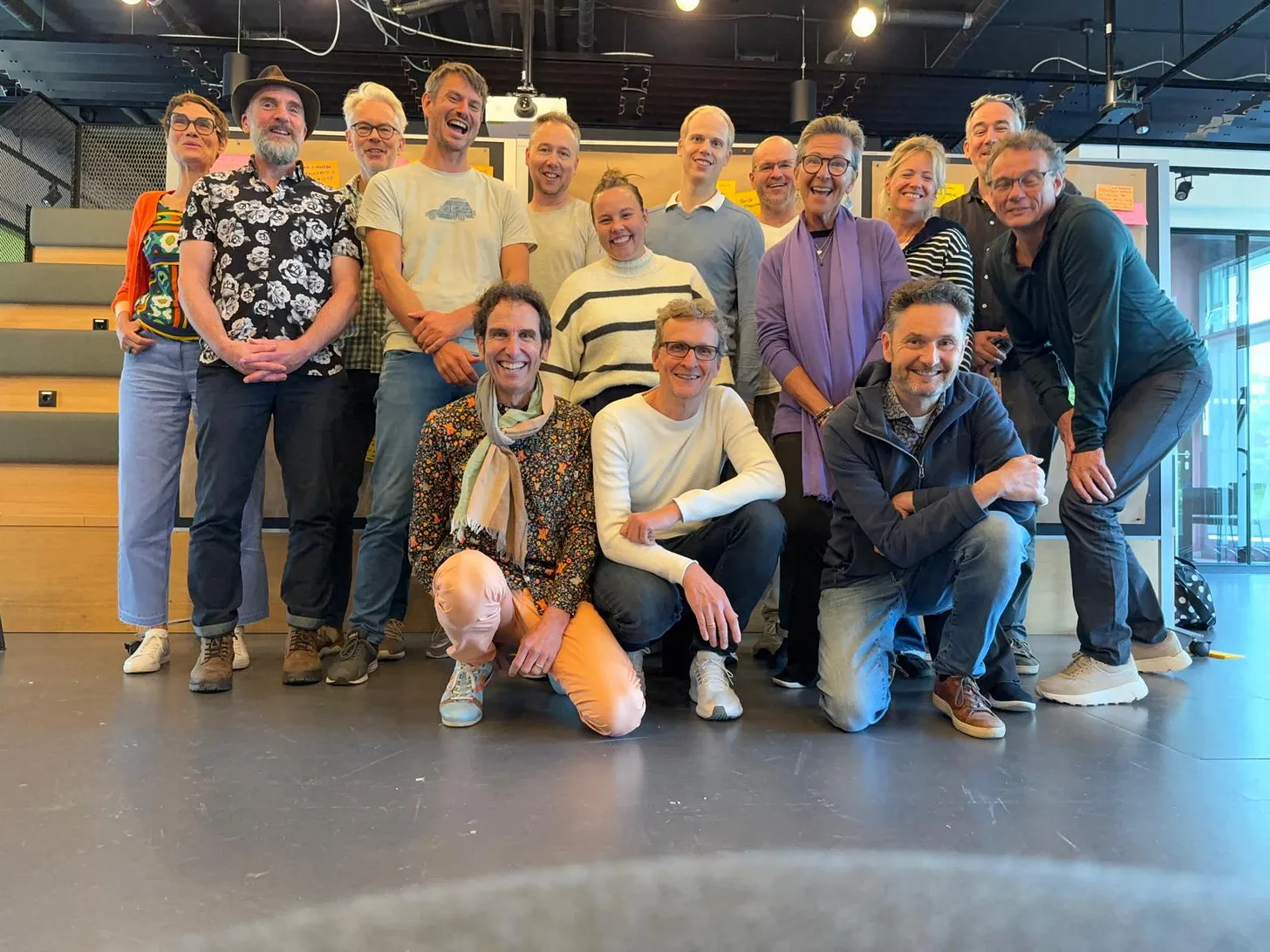
In September 2025, I was in Berlin with a group of fellow Holacracy practitioners who'd all spent years working with approaches to self-management in organisations. We'd organised to come together in-person again ourselves after the gap left by HolacracyOne no longer running the Holacracy Forum, and to work out what, if anything, we still shared. What happened over those three was remarkable.
My colleague Marco Bogers, from Work in Flow, who co-facilitated that gathering, wrote about and I want to share it here because it captures something this series has been pointing to since it began.
What emerged in Berlin was not a new method. It was the recognition that we are stewards of a commons, a living practice that doesn't belong to anyone. That shift from owning a method to tending a field is one of the most concrete examples I've encountered of what it looks like to step outside machine-paradigm thinking. Not in theory. In a room, with people, over three days.
Marco wrote this reflection on his Substack in October 2025 and he's given me permission to republish it as part of this series. Thanks Marco.
In this article:
In September 2025, something long in motion finally took shape in Berlin.
Among a gathering of Holacracy coaches, the field recognized it had begun to move beyond its methods*.
What emerged was more than a network: it was the beginning of a commons of practice — a turning point from method to field, from system to stewardship.
This is a personal reflection on that gathering.
The air in the Hypoport atrium in Berlin buzzed with quiet anticipation.
No agenda, no program. Just people arriving, saying hello, putting down their suitcases, and forming a circle.
I felt my chest tighten. Did we have enough chairs? Should the circle be bigger? Did I know all the people?
A sense of quietness descended into the room as everybody was seated.
My colleague Tom started by welcoming everybody in his usual matter-of-fact style, after which the group proceeded into a check-in.
It had been many years since most of these people had gathered in a physical space. Most of them were certified Holacracy coaches. We used to have yearly events in Amsterdam, but since the pandemic they had not happened anymore. Of course, since Corona there had been online meetings, but it was difficult to keep the connection — and, most importantly, the spirit of the practice — alive.
A series of meetings had started out of frustration, which eventually evolved into a longing for a new way forward.
The check-in was pop-up style. Someone spoke, another continued. The empty space filled with sounds and words.
I felt my shoulders drop and listened closely — not only to the people, but to the themes that were present in the room.
Then I shared them with the group:
“I heard clarity, joy, purpose, commitment, emergence, curiosity, connection, a way forward.”
Interestingly, a word that was mentioned a number of times was “the field.”I felt excited because I realized this wasn’t just a meeting — it was the field trying to find itself again.
Liminal space
After the check-in the group sits quietly. Someone clears their throat, then silence again.
I feel restless. What are we going to do now? Who’s in charge? My mind keeps reaching for a program, for a leadership that doesn’t yet exist. So, how are we going to get through all these themes? There are a lot of questions to be answered.
Then I exhale. We can hold this. This is what we are all trained for: holding tension. Being in this liminal space is what brought us together.
On the other side of the room, boards with brown papers wait. Sticky notes and pens lie scattered across the tables.
Tom steps aside and points to me. “So Marco, it’s your turn now.”
My heartbeat quickens. Before lunch I volunteered to facilitate.
I step forward.
The air seems to shift — the stillness turns into motion.
The beginning
I can feel the tension and anticipation in the room. How are we going to make this tension productive together? How can we let structure arise from the field so the right conversations can take place?
Tom starts to distribute post-its, and soon everyone is silently writing.
I breathe out and start to write down my own tensions.
After five minutes, time is up. I ask each participant to step forward. One by one they explain their tensions and place them on the board.
The field begins to take shape — yellow post-its forming constellations on brown paper.
I’m excited. It works.
We made a simple choice for a structure — Open Space — and gave it a twist: everyone contributes to setting the agenda, followed by clustering and voting.
I think of other contexts where clustering turned chaotic. But this time, as we do it in silence, a calm focus settles over the room.
Order slowly emerges from the chaos.
Next comes the hardest part — decision-making. Will the dot voting work? Will participants take up facilitation roles? A familiar worry flickers in my mind.
I explain the rules. People start to move around. Dots appear everywhere. Groups form around clusters. Leaders step forward. I am amazed how smoothly it all goes.
Of course — we are all seasoned facilitators. Leading groups has become almost second nature.
Still, something feels different.
This isn’t just facilitation — it’s the field organizing itself through us.
Fork in the Road
Conversations burst into life. People scatter across the room, some at a big table, some in a corner, grabbing chairs, writing on flipcharts. I drift between the tables, catching fragments of what people are saying. I feel a bit of disorientation. What are we actually trying to understand?
One group is seated near the big glass doors, looking out at the court yard. The post-it in the center of their table reads “grief”. The air around them feels heavier, slower.
A part of me wants to avoid this. Do I really want to go there — into that emotional terrain? - I take a seat at the edge of the table. I listen to the stories. I feel there is relief in sharing it. After some time the atmosphere lights up. Jokes are made.
Time to get off the “pain train” step back and scan the room. Conversations seem to happen at a slower pace. I join a few other sessions. The conversations are intense, eager to share, searching. I feel the intent is building up. But still, at the end of the first day I can’t yet make sense of what is happening in the field, and what direction it will take us.
And yet, we did “check a lot of boxes”. Connection, joy, and a lot emergence en curiosity. But I still wonder. Am I truly in this? Have we committed to the journey or just reenacted a ritual? I write four words at the bottom of the page in my notebook:
“Fork in the road!”
A way forward emerges
The next morning the room fills slowly. the scent of fresh coffee drifts through the atrium as people settle in.
We do a check-in. The session board is still full from yesterday. But somehow the items that were written down don’t feel so urgent anymore. Maybe it was the soft energy of the check-in, or simply a night’s rest. It’s like I can see yesterday now from a distance.
We do a new round and new items appear, words that were already floating around during the first days, find their way to the boards. “Exploring the commons”, “Stewarding”, “Defining the Profession”, “Validating the purpose”. During the voting I watch dots accumulate around a few new post‑its. I feel a subtle shift. We’re no longer lost. We’re seeking and a path is forming itself.
I grab my coffee, and join a group. The morning session begins to unfold. The discussions I join during this day are different from yesterday. We are no longer asking ourselves what is broken. Now, we’re asking how to move forward.
One group discusses “What does stewarding actually mean?” I am triggered by my curiosity and a sense of discovery, so I join. The word seems to open something. Guarding, guiding, parenting, caring. For me it is not mental concept or a method, but a feeling, something I feel I can relate to personally.
Someone says, “It’s not about locking it down — it’s about keeping it alive. We don’t want proprietary protocols, we want living practices. Yes!!We are stewarding a living practice— not owning it. Not just repeating it, or “implementing” it. We are living it. Right here, right now.
When someone mentioned the idea of a living practice that changed how I saw the day. And the word practice started to bear meaning. As something that is embodying a transformation.
At the end of the afternoon the sun breaks through in rainy Berlin. The sunlight falls on the greenery in the courtyard, brightens up the dark colors the atrium. It is also as if the clarity builds. The field, which was still cloudy in the morning starts to get more clear. The conversations become more concrete, there is excitement. We are together uncovering something here.
We hover on the edge of “naming something into existence”, but we could still lose it. Commons, Practice, Stewarding. I feel almost sad that the discovery phase is over. I love wondering around and doing this kind of work. At the same time, the tension of not naming our identity is building. Do we rush the naming and risk flattening it — or wait and risk letting the momentum fade?
The group agrees to call it a day and leave it to the final session tomorrow. I close my notebook and inhale the satisfaction of fruitful day of work.
Who are we?
The atrium hums with suitcase wheels and quiet greetings. Like the first day, people arrive and leave their luggage near the big dark outer wall. In the afternoon we will all be on our way again. The tables are full with flip charts, the boards with post-its. I stand in front of them, overwhelmed. The abundance is inspiring — but also intimidating.
After the check-in, the flipcharts are put on the windows and we start to do a “Gallery walk”. We start to write down conclusions, projects and actions. The silence of the gallery walk only deepens the feeling: we haven’t really gone to the essence yet of who we really are, and we only have a few hours. Nick steps forward en proposes we drop the harvesting for now, and move right on to a governance meeting.
Floris puts forward a proposal for a purpose statement. Nick facilitates. As we go through the rounds, the proposal gets more clear. It’s quite hard to distill every conversation and all the feelings that we have about what we experienced into a few sentences.
How do you name something that you felt, and which every name you give to it actually reduces it to something much less intense, much less deep? I think of the phrase: “Anything that can be named is not the true Tao.” But we have to name it anyway.
I truly feel this tension when the word “self-management” comes up. For me, self-management is a flat term which does not do respect what this work is all about, it is like going back to something more crude and simple. I even think of making an objection.
It takes a long time and very skilled practice facilitation to guide us through the process. The energy is quite different from the previous days. It feels hard and even painful, but we all stick with it because we know the process and we trust it.
After the last objection round, my objection energy fades, then something releases in me — not full agreement, but peace. We accomplished something and we stuck with the practice even when it became difficult. We didn’t get the perfect outcome. But we got a living one — and for me, that’s more real.
At the end of the morning, the flipchart reads:
We are stewards of a commons and a community of practice around a curated set of field-tested self-management practices
We call ourselves: Self-Management Collective
Making sense of it all
As I read over my notes and try to capture it in words, I realize this article is my attempt to make sense of it all. Breaking it into scenes and sequences revealed patterns I didn’t notice in the moment — a flow from confusion to clarity, from separation to coherence.
I think the narrative structure really helped me to see what happened and what we went through. It was certainly an extraordinary event which took place at the right place, at the right time, with the right people. It was the kind of synchronicity where the right word appears at the right time — not by planning, but by presence.
Because of this, things could arise. As a thinker my mind is racing to put a model on it or to find an explanation or to distill the learnings into replicable parts. But I think what we went through was much more.
We are all people making a living of introducing structures to organizations. Yet, as structure-makers we danced without a script — and still stayed in rhythm. That, to me, was the deeper mastery. And in the end, we did use a firm structure to ground ourselves…
For me, what it actually meant in the 10 years I have been practicing—still getting used to the words self-management—is that we all matured, and the practices matured and the field matured.
We moved from doing methods* to being a field. From facilitating something external to embodying something shared.
So I felt very grateful … to be one of the stewards. Gratitude, yes — but also a sense of quiet responsibility. Stewarding isn’t a badge. It’s a practice I feel called to now.
*Participants were versed in several methods, like Holacracy, Getting Things Done, Source Principles, True Purpose, Sociocracy, Deep Democracy, SCT, Agile/Scrum, etc.
End of Marco's article.
My Conclusion
What Marco describes, the difficulty of naming something without flattening it, the objection that fades into peace rather than agreement, the purpose statement that's imperfect but living, that's what it looks like to work from inside a system rather than above it.
The machine model has an answer for all of this: cleaner governance, better facilitation, a tighter brief. What it doesn't have is a way to hold the fact that the most important thing that happened in Berlin wasn't on any agenda. It arose. And the group was developed enough, structurally and relationally and in terms of what each person could hold, to let it.
That's the territory this series is mapping. Not from the outside. From inside it.


