
#16 Feedback as Infrastructure Maintenance: Why Your Feedback Culture Isn't Working
Quick Summary
Many people say they want a culture of open, honest feedback in their team — but what they actually experience is judgment — something a manager delivers, usually awkwardly, usually too late. Training people in feedback techniques doesn't fix this, because the problem isn't skill. It's that there's no relational foundation to make honest exchange safe. The Matrix Leadership approach, developed by Amina Knowlan at the Matrix Leadership Institute, reframes feedback entirely: not as evaluation but as data about impact, exchanged peer-to-peer as a normal part of how a group maintains the health of its relationships. This article explores why that reframe changes everything — and why appreciative feedback must come before the hard conversations, not as a warm-up exercise but as a structural requirement.
What's in this article:
The Feedback Problem Everyone Recognises
Why Conventional Approaches Don't Stick
The Reframe: Feedback as Data About Impact
The Feedback Problem Everyone Recognises
"Can I give you some feedback?"
Five words that make almost everyone's stomach drop. Not because we don't believe in feedback — most of us would say we value it. But because what typically follows rarely feels like a gift. It feels like a verdict.
You know how this plays out. The annual review where your manager reads from a form neither of you believes in. The sandwich technique so transparent you're bracing for the "but" before it arrives. The 360-degree review full of anonymous opinions from people who never said any of it to your face. Or the corridor version — "some people have concerns about your approach" — feedback laundered through enough intermediaries that no one has to own it.
Almost every team I've worked with says they want a feedback culture. Almost none of them have one. What they have instead is a set of rituals — review cycles, feedback forms, occasional training days — that everyone endures and no one finds particularly useful. Underneath it all, most people experience feedback as judgment. And when you're anticipating judgment, your nervous system goes into protection mode. You defend, deflect, or simply wait for it to be over. The conversation that was supposed to build the relationship quietly erodes it instead.
The standard response is to train people in feedback skills. Learn the SBI model. Read Radical Candor. Practise nonviolent communication. These aren't bad frameworks. But they treat feedback as an individual competency problem — as if the reason feedback doesn't flow is that people haven't learned the right words yet.
That's not what's actually missing.
Why Conventional Approaches Don't Stick
The reason feedback training rarely creates a feedback culture is that it addresses the wrong layer. Teaching people a technique for delivering difficult messages is like teaching someone to drive without building any roads first.
In the previous article in this series, I explored what Amina Knowlan calls relational infrastructure — the consciously developed web of person-to-person connections, trust, and communication norms that allows a group to function as an interconnected system. That infrastructure is what makes honest exchange possible. Without it, even the most skilfully delivered feedback lands on a minefield.
Think about it from the receiver's perspective. If someone you barely know, or someone you don't fully trust, says "Can I share how that decision landed for me?" — the words might be technically perfect, but they still feel unsafe. You don't know their intent. You haven't built the connection that would let you hear their words as care rather than criticism.
This is why so many feedback initiatives produce a brief flurry of awkward conversations and then quietly die. The question isn't whether your team knows how to give feedback. It's whether the relationships between people are strong enough to carry it.
The Reframe: Feedback as Data About Impact
In the Matrix Leadership framework, feedback is redefined in a way that shifts the entire dynamic. It's not something a manager gives to a direct report. It's not an evaluation of someone's performance or character. Feedback is data about impact — your honest account of how someone's behaviour or words landed for you, shared directly with them, as an investment in the relationship and the work you're doing together.
That reframe matters because any group doing real work together needs constant feedback loops — to recognise what isn't working and make course corrections, and equally to strengthen and amplify what is. Without those loops, the group is flying blind. The shift — from evaluation to data, from top-down to peer-to-peer, from judgment to investment in the relationship — changes everything.
But the Matrix approach doesn't start where most people expect. It doesn't begin with the hard conversations. It begins with appreciation.
Appreciative feedback comes first — and this isn't a warm-up exercise. It's a structural requirement. Before a group can handle honest, differentiating feedback, it needs what Amina calls a ground of health: a foundation of trust and genuine positive regard that has been deliberately cultivated. You build this ground by doing something most teams skip entirely — taking the time to tell people, directly and specifically, what you value about working with them.
This isn't toxic positivity. It's investing in the relational connections so that when those connections need to carry something heavier, they can. Research on high-performing teams consistently points to something in the range of a 5:1 ratio of positive to critical interactions — not as a formula, but as a diagnostic. If the ratio is significantly lower, people will hear criticism as threat, not data, regardless of how carefully it's worded.
Differentiating feedback follows once the ground is established. This is the real maintenance work — your honest account of the impact of someone's behaviour on you. Not a diagnosis of their character, but data about what happened between you. The formula is deceptively simple: "When you did X, the impact on me was Y."
In the previous article, I described a leadership team member who turned to a colleague and said: "When you reversed that decision last week without talking to me, it felt like my judgement didn't count. I want to understand what was driving that." That's differentiating feedback. It's specific. It's owned — "the impact on me" rather than "you are wrong." And it's directed to the person, in the open.
The crucial distinction is between giving feedback and sharing data about impact. "Giving feedback" implies someone in authority dispensing truth. "Sharing data about impact" implies a mutual exchange between peers invested in understanding how they affect each other. The first creates defensiveness. The second creates connection, even when the content is difficult.
And notice: you can also ask for this data. "When I made that call on the budget without consulting you — what was the impact?" That question, asked genuinely, does more for a relationship than a hundred sandwich-technique reviews.
The Difference Between Feedback and Projection
There's a trap worth naming. Not everything that feels like feedback actually is feedback. In an earlier article, Kenny Whitelaw-Jones explored how our psychological shadows show up as projection. The signature phrase is "They are too..." — too controlling, too passive, too emotional. That feels like an observation about the other person. It's actually unprocessed data about yourself, directed outward.
The practical test: am I describing the impact of a specific behaviour on me? Or am I diagnosing someone's character? "When you made that decision without consulting me, I felt sidelined" is feedback. "You're too controlling" is projection. The first invites a conversation. The second invites a fight.
What Becomes Possible
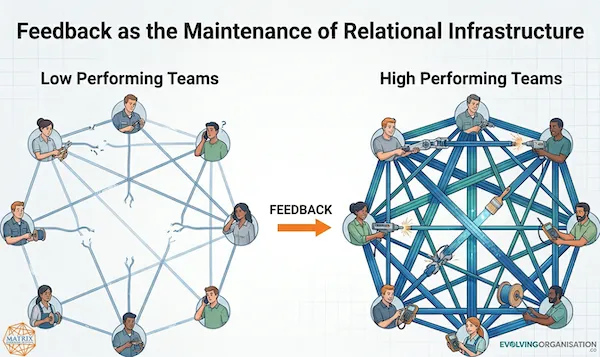
When feedback flows as a normal part of group life — appreciative and differentiating, peer-to-peer, in the open — the relational infrastructure that connects a team doesn't just get built once and left to erode. It gets maintained. Small misalignments get caught early. Appreciation becomes visible instead of assumed. And the group develops something rare: the capacity to stay honest with each other over time.
I've seen teams reach a point where someone can say "that's not landing for me" in a meeting and it doesn't derail anything — it's just data, received and worked with. The group stops being fragile. It becomes genuinely adaptive — able to sense what's happening between people and respond to it, rather than waiting until the damage is done. And that capacity doesn't stay contained within one team — it's how organisations begin to develop the collective intelligence to navigate complexity that no single leader could manage alone.
Something to Try This Week
Here's an invitation for this week. Pay attention to your own feedback patterns. When you notice something about a colleague's impact on you — positive or difficult — what do you do with it? Do you go direct, or do you route it somewhere else? Do you say the appreciative thing out loud, or do you think it and move on? You don't need to change anything yet. Just notice.
Next week, we'll explore what happens when a group moves beyond pairs — when everyone takes responsibility for the quality of the group's interaction as a whole, not just their own conversations. That one comes with an experiment you can try.
These practices — appreciative feedback, differentiating feedback, the broader relational infrastructure they depend on — are learnable, but they're hard to learn alone or from a book. They need a group to practise in. The Evolving Collective Leadership programme, a founding cohort starting 14 April co-developed with Amina Knowlan at the Matrix Leadership Institute, is built around exactly this: practising these relational capacities together in a real group, with experienced facilitation, over four months. Founding cohort members receive a 33% discount. Details and registration →


