#15 The (Relational) Infrastructure No One Builds
Quick Summary
Most teams trying to work beyond hierarchy focus on structure — clearer roles, better processes, new governance. But one of the (many other) foundations that we are exploring in The Beyond Hierarchy Project that determines whether any of those changes actually work is something far less visible: the web of person-to-person connections, trust, and communication norms that lets a group function as an interconnected system. Research consistently shows that how people communicate and relate to each other predicts team performance more than individual talent or formal structure. This article names what's missing — relational infrastructure — and introduces one of the foundational practices that build it: person-to-person communication, drawn from the Matrix Leadership framework developed by Amina Knowlan at the Matrix Leadership Institute.
In this article:
The Patterns Everyone Recognises
You know the pattern. You've seen it enough times.
Someone on the team does something that frustrates you — drops a ball, makes a decision you disagree with, says something in a meeting that lands badly. And instead of turning to them and saying so, you mention it to someone else. Over coffee. On a walk back from lunch. In a quiet aside after the meeting. "Did you notice what they said? I can't believe they did that again."
It feels natural. It feels like processing. And almost everyone does it.
Or consider the team member who has a problem with how a colleague handles client handovers. Rather than raising it with that person, they escalate to their manager. The manager now carries the tension. The two people who actually need to work it out never speak directly. And the next handover goes exactly the same way.
Or the meeting where the group discusses someone's behaviour — their lateness, their tone, their missed deadlines — without that person in the room. Everyone nods. Everyone agrees it's a problem. Nothing changes, because the person who could actually change never heard the conversation.
These aren't dramatic failures. They're the quiet, daily erosion that most teams accept as normal. Corridor conversations. Back-channel deals. The slow fragmentation of a group into subgroups with separate narratives about what's really going on.
If you lead a team, you already know these patterns. You can probably feel them in your body as you read this — the slight weariness of recognition. What you might not have named is what's actually degrading. It's not "communication skills." It's not "team culture." It's something more structural than either of those, and it's almost always invisible until it's too far gone.
What's Actually Missing
Earlier in this series, Amina Knowlan — the founder of the Matrix Leadership Institute, whose work on collective leadership has shaped much of my more recent learning about how groups function — introduced a reframe that has stayed with me since. In her article Shifting Beyond Hierarchy Means Going from Control to Connection, she pointed out that when most of us sit down in a group, we see individuals: 1 + 1 + 1 + 1 + 1 + 1 + 1 = a group of seven. But a group is actually a set of relationships. That same group of seven has twenty-one connections between its members. And it's the health of those connections — not the talent of the individuals — that determines whether the group can function as a system.
Once you see a team that way, the pattern behind those everyday symptoms starts to come into focus. The corridor conversations, the escalations, the meetings about absent people — these aren't problems of individual behaviour. They're signs that the connective tissue between people has degraded. And most teams respond by trying to fix structure — reorgs, new project management tools, values workshops, team-building days — when the gap isn't in the structure at all.
It's in the infrastructure underneath it. Like building a shopping centre in a neighbourhood with no roads. The structure exists, but nothing flows through it.
What Amina calls relational infrastructure is the consciously developed web of person-to-person connections, trust, and communication norms that allows a group to function as an interconnected system rather than a loose collection of individuals. It's not a metaphor. It's as real and as consequential as the physical infrastructure of a city. Roads enable traffic. Electrical grids enable power. Relational infrastructure enables teamwork — the kind where people coordinate effectively, surface problems early, give honest feedback, and adapt together under pressure.
When this infrastructure is strong, teams do things that look almost effortless from the outside: they self-organise around emerging priorities, catch errors before they cascade, make decisions without bottlenecks, and hold each other accountable without needing a manager to play referee. When it's weak, you get the symptoms everyone recognises — and structural fixes that never quite land.
The research on this is remarkably consistent. The MIT Human Dynamics Lab, led by Alex Pentland, found that communication patterns — not the content of what people said, but the patterns of who talked to whom, how often, and how directly — predicted more of the variation in team performance than any other single factor they measured (more of this to come later in an experiment). Google's Project Aristotle, studying hundreds of its own teams, identified psychological safety as the number one predictor of team effectiveness — and psychological safety is, at its core, an outcome of having a strong relational infrastructure. Multiple evidence reviews confirm the same finding from different angles: social cohesion and the quality of relationships within a team predict a larger share of performance variance than individual talent or formal structure.
Think about what that means. We spend enormous energy hiring the right people, designing the right org chart, implementing the right systems. And the single biggest determinant of whether any of it works is something most teams never consciously build.
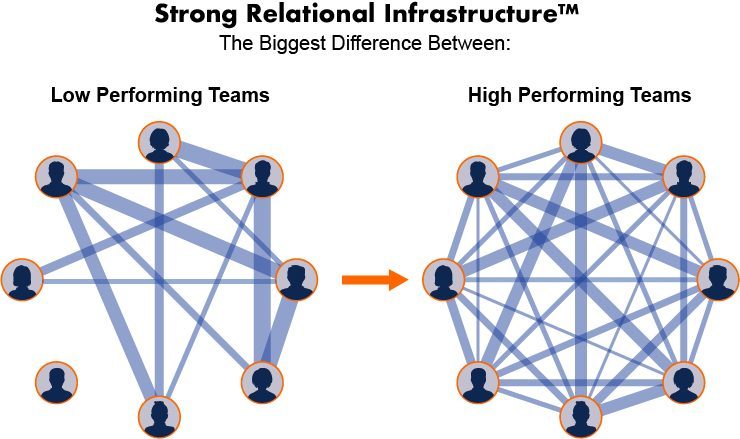
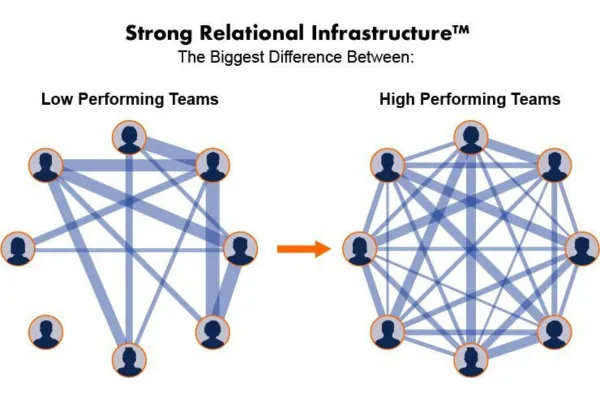
The diagram above, from the Matrix Leadership Institute, shows this visually. On the left, a low-performing team: some people are heavily connected, others barely linked, and at least one person sits almost outside the web entirely. Communication flows through a few dominant channels. On the right, a high-performing team: every pair is connected, the web is dense and evenly distributed, and no one is isolated. Same people. Same number of people. Completely different infrastructure.
The question is: what builds those connections? How do you move a team from left to right?
The Practice That Builds It
In her follow-up article The Essential Components of Collective Leadership, Amina laid out six practices that shift leadership from something located in individuals to something that emerges from the interactions of all members. She described three that create connection and three that support healthy differentiation — the two fundamental requirements for any group to function as a living system. Person-to-person communication is the first of the connection practices she names, and it is foundational. Nothing else in the framework works without it.
The practice sounds simple: when you speak in a group, speak directly to a specific person, not about someone to the group, and not to the group as an undifferentiated whole. Address a real human being. Make eye contact. Direct your words to them. As Amina puts it:
Talk directly to each other "in the open — in the group."
Each time you do, you establish a communication channel between that pair of people, in the presence of the whole.
This might sound unremarkable until you notice how rarely it actually happens.
Watch most teams in a meeting. People speak "to the room." They make general observations. They address "the team" or "everyone." They share a concern about someone's work by raising it as a general topic — "We need to talk about how handovers are going" — rather than turning to the specific person and saying, "I want to share something with you about how the last handover landed for me."
The difference isn't just stylistic. It's structural. When someone speaks to the group in general, the words float. No one specific receives them. No connection is formed or strengthened. When someone turns to another person and speaks directly — with honesty, with care, in the open where the whole group witnesses it — something tangible happens between those two people. A connection is made or deepened. Trust is built or tested. The relational web between that pair gets stronger. Look at that diagram again: each line in the high-performing team on the right represents a communication channel that was built, one direct conversation at a time.
But here's something crucial that's easy to miss: you don't build those channels by starting with the hard conversations. If the idea of speaking directly to a colleague about a tension — in front of the whole team — makes you tense, that's a healthy instinct. Without trust already in place, it wouldn't be courageous. It would just be confrontational. In the Matrix Leadership framework, person-to-person communication is combined with two other connection-building practices- one of which is what Amina calls cultivating a ground of health (more on that another time) — intentionally building trust, positivity, and genuine connection between people before those channels are asked to carry anything difficult. You start with what's simple and human: turning to someone and telling them what you appreciate about working with them. Asking what lights them up outside of work. Sharing something real about yourself. These aren't warm-up exercises or those contrived arse-twitching icebreakers. They're how the infrastructure actually gets laid — connection by connection, one honest exchange at a time. The hard conversations become possible later precisely because the ground has been prepared.
I saw this sequence play out vividly in a leadership team I worked with a few years ago. They'd spent weeks building genuine person-to-person connections — learning to speak directly to each other about the small things first, the appreciations, the curiosities, the everyday observations that most teams never voice. So when a real tension surfaced around a colleague's tendency to override decisions made by others, those connections were strong enough to hold it. One of the team turned to him in a meeting and said, simply: "When you reversed that decision last week without talking to me, it felt like my judgement didn't count. I want to understand what was driving that." The room went quiet. It was uncomfortable. But he responded — not defensively, but with genuine surprise. He hadn't realised the impact. They talked it through, in front of the whole team. And something shifted — not just between those two people, but in the room. Everyone had witnessed a direct connection being made where there had been a gap. That moment was possible because the ground of trust was already there.
When person-to-person communication breaks down — when people default to talking about each other rather than to each other — the infrastructure degrades. Every indirect conversation is a bypass that weakens the web. Information travels through distortion. The group fragments, the diagram starts looking like the left side again, and you end up with the very symptoms that send leaders searching for structural fixes.
The practice also changes the group's relationship with its own leadership. In most teams, the manager or founder becomes the default routing node for every interpersonal tension — people come to them rather than going to each other. As person-to-person communication strengthens, that pattern naturally shifts. The leader stops being the switchboard and becomes one node among many in a genuinely interconnected network. This is one of the practical mechanisms by which teams begin to self-organise.
Why This Is Harder Than It Sounds
If you've read this far and thought "that sounds right, but it also sounds really hard" — you're paying attention.
Speaking directly to someone in front of the whole team — about something that's bothering you, or something you appreciate, or something you need — requires courage. It requires a willingness to be uncomfortable in the short term for the sake of the relationship and the group. Most of us were not trained for this. We were trained — by families, by schools, by workplace cultures — to manage discomfort indirectly. To be diplomatic. To triangulate. To find allies before confronting.
In the previous article in this series (#14 How Our Personal Shadows Secretly Sabotage Self-Managing Teams), Kenny Whitelaw-Jones explored how our psychological shadows — the emotions, fears, and impulses we've learned to hide — shape how we relate to power and to each other at work. He described how projection travels along the lines of relationship: one person's unspoken judgement becomes a story shared over coffee, then a whispered consensus, until a whole team relates to another person through a distorted lens rather than direct contact. Going indirect — talking about rather than to — isn't just a communication habit. It's often the route our shadow prefers for projections we're not ready to own. The practice of person-to-person communication is also, quietly, a practice of interrupting that relay system.
This is why relational infrastructure doesn't get built by accident and doesn't hold up without ongoing investment. It requires a group to make a conscious commitment to a way of relating that often runs against deeply ingrained habits. It's not a one-off workshop outcome. It's a practice — something you get better at over time, that gets easier as the trust deepens, and that produces compounding returns as the group discovers what becomes possible when the web of connections is strong. And it's why the person-to-person practice is only one of six practices — which all need to be there to create the necessary conditions for relational health.
What Becomes Possible
When person-to-person communication becomes the norm rather than the exception, teams resolve tensions faster, meetings come alive, and feedback flows naturally because the channels are already open. But the deeper shift is that the group starts to function as something greater than the sum of its parts. In Amina's words, groups with these capacities in place become
living, breathing, fluid, stable and resilient organisms whose collective intelligence and wisdom are informed by the Whole.
I know that sounds idealistic, and yes, it is unfortunately rare, but I have seen it happen, and it's unmistakable when it does. And it’s one of the conditions required for Self-Managing Teams to actually deliver on their promise of new ways of working beyond hierarchy. The team starts sensing and responding to what's emerging rather than waiting for someone at the top to direct the response.
None of this requires dismantling hierarchy overnight (which of course is impossible) or implementing a new governance framework. It starts with something much simpler and much harder: the willingness to turn to the person next to you and say what you actually think, directly, with care, in the open.
Here's an invitation, if you're willing.
Think about your team and those twenty-one connections — or however many your group has. How many of them are strong, open, and direct? How many are held together by back-channels, assumptions, or the goodwill of a manager shuttling between people? And what would it take for you to strengthen just one of them this week — by going direct where you'd normally go around?