
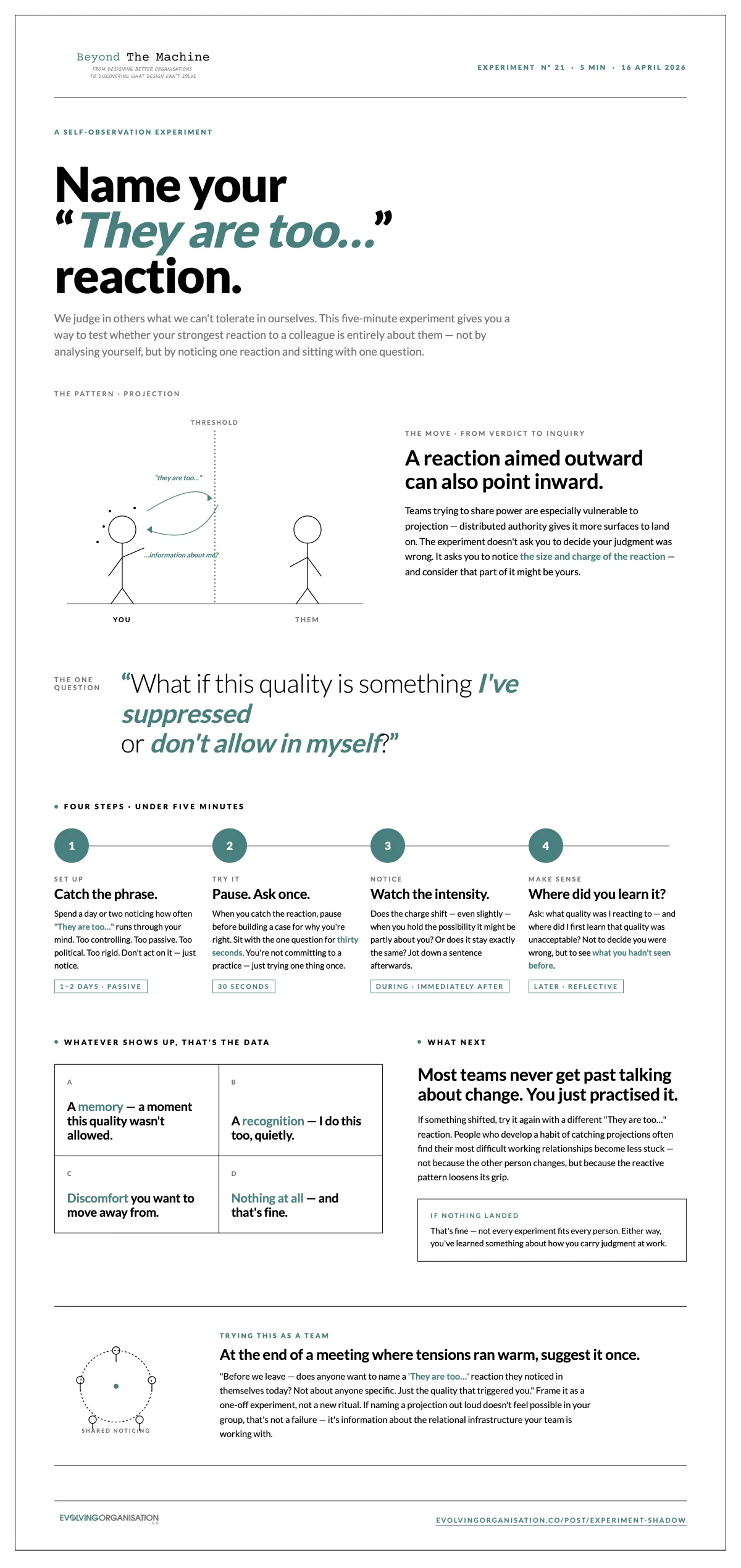
#22 EXPERIMENT: Name your "They are too..." reaction
Quick Summary
In the Shadow at Work series (Part 1: How Our Personal Shadows Secretly Sabotage Self-Managing Teams, Part 2: Relational Shadows, Part 3: Collective Shadows), we explored how the parts of ourselves we've learned to hide — our shadow — silently shape how we relate to power, authority, and each other at work. The pattern that came up most: projection. We judge in others what we can't tolerate in ourselves, and those judgments get mistaken for accurate assessments of "difficult" people. Teams trying to share power are especially vulnerable to this because distributed authority gives projection more surfaces to land on.
Most of us have never tested whether our strongest reactions to colleagues are entirely about them. This experiment gives you a way to check — not by analysing yourself, but by noticing one reaction and sitting with one question. It takes less than five minutes, and you can try it in a situation you're already in.
THE EXPERIMENT: What You're Exploring
The question: What happens when you treat a strong reaction to a colleague as information about yourself — not just about them?
1. Set Up
When to try it: The next time you notice yourself thinking some version of "They are too..." about someone at work. Too controlling, too passive, too political, too emotional, too rigid — whatever your version is.
Before you try the experiment itself, spend a day or two just noticing how often that phrase runs through your mind — and notice how obvious it feels each time that the reaction is entirely about the other person. You don't need to do anything about it. Just notice. Most people are surprised by the frequency, and by how certain they are.
2. Try It
When you catch a "They are too..." reaction — in a meeting, after an email, during a conversation — pause before you do anything with it. Instead of building a case for why you're right about them, ask yourself one question:
"What if this quality is something I've suppressed or don't allow in myself?"
You don't need to answer it definitively. You don't need to decide whether it's true. Just sit with the question for thirty seconds and see what comes up.
That's it. One reaction, one question. You're not committing to a new practice — you're trying one thing once.
3. Notice
During and immediately after, pay attention to how the intensity of your reaction changes. Does it shift — even slightly — when you hold the possibility that part of it might be about you? Or does it stay exactly the same?
Also notice what surfaces when you ask the question. It might be a memory. It might be a recognition. It might be nothing at all. It might be discomfort you want to move away from quickly. Whatever shows up, that's the data.
If you can, jot down a sentence or two straight afterwards — on your phone, in a notebook, wherever works. What you noticed will be clearer now than it will be tomorrow.
4. Make Sense
Once you've had a chance to sit with it, ask yourself: What quality was I reacting to — and where did I first learn that quality was unacceptable?
This isn't about deciding your judgment was wrong. Sometimes the other person really is being controlling, or passive, or political. It's also about noticing the strength and emotional charge of your reaction — whether the size of it is proportionate to what the other person is actually saying or doing. The question isn't whether your reaction is justified. It's whether all of the reaction is about them, or whether some of it is yours.
Whatever you noticed — expected or surprising, encouraging or uncomfortable — that's useful. The point isn't to get a particular result. It's to see something you hadn't seen before.
What Next?
If something shifted or got interesting, try it again with a different "They are too..." reaction. People who develop a habit of catching their projections often find that their most difficult working relationships become less stuck — not because the other person changes, but because the reactive pattern loosens its grip. If nothing landed, that's fine — not every experiment fits every person. Either way, you've learned something about how you carry judgment at work.
Share What You Noticed
We're building a shared picture of what happens when people try these experiments — what shifts, what doesn't, what surprises people. If you'd like to add what you noticed, it takes about two minutes and helps the research. Share what you noticed →
Trying This as a Team
If you want to try this with your whole team rather than on your own, keep it simple. At the end of a meeting where tensions ran warm, suggest something like: "Before we leave — does anyone want to name a 'They are too...' reaction they noticed in themselves today? Not about anyone specific. Just the quality that triggered you."
Frame it as a one-off experiment, not a new ritual. People are more willing to try something when it's clearly time-limited and low-stakes. If the team tries it, take two minutes at the end to ask each other: "What did we notice?"
A word of honesty: this team version asks for more psychological safety than many teams currently have. If naming a projection out loud doesn't feel possible in your group, that's not a failure — it's information about the relational infrastructure your team is working with. Building that infrastructure is exactly what Evolving Collective Leadership is designed to do — a four-month programme focused on the relational practices that make this kind of honesty sustainable, not just brave. Find out more →
Learn from Others Who Did the Experiment
Kenny and Nick who co-wrote the Shadow Series of articles are running a live session on Wednesday 6 May, where people who tried this experiment can share what they learned. It's informal — bring your observations, your questions, or just your curiosity. You don't need to have tried the experiment to join. Link to register →
How Does this Apply to Your Work?
However this went — whether it shifted something, felt strange, or landed flat — you tried something different. That matters more than it sounds. Most teams never get past talking about change. You just practised it.
If something surfaced that you want to think about with other people working in this territory, the Beyond the Machine: Live sessions are where that conversation happens. Monthly drop-in, first Wednesday of each month. Details and booking here →

